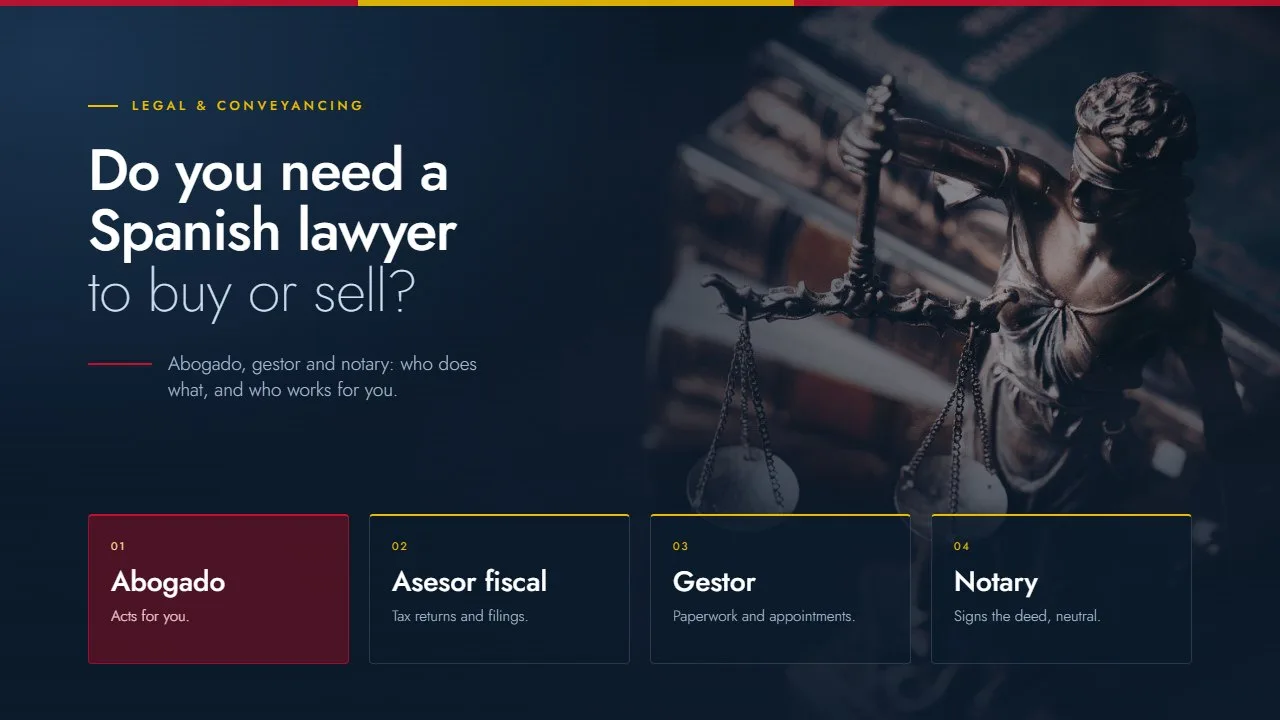

A Spanish lawyer is called an abogado. If you are buying or selling property in Spain you should have one acting for you, because nobody else in the transaction is there to protect your interests. This guide explains what an abogado does, how that differs from the notary, the gestor and the tax adviser, what a lawyer costs, and how to check that the person you are about to hire is registered to practise.
The short answer
Spanish law does not require you to use a lawyer to buy or sell property. In practice the notary is the only professional you cannot avoid, because registering your title at the Land Registry requires a public deed signed before a notary. The notary, however, acts for neither party. Unless you appoint your own abogado, nobody checks the property, the seller, the debts, the licences or the contract on your behalf. That is why every foreign buyer and seller should instruct an independent abogado registered with a Spanish bar association, a Colegio de Abogados, and paid by them alone.
Whatever your home country calls its lawyers, solicitor, attorney, advocate or notary-lawyer, the Spanish equivalent for property work is the abogado. Spain has one type of lawyer for advice and representation: an abogado advises, drafts contracts and represents clients in court. English-speaking firms in Spain often describe themselves using the term their clients know, but they are firms of abogados, and it is the registration behind the name that matters.
Who does what in a Spanish property transaction
| Who | What they are | What they do for you | What they do not do |
|---|---|---|---|
| Abogado lawyer, solicitor |
Law graduate who completed the professional master and state access exam, or qualified under the pre-2011 rules, and is registered as a colegiado with a Colegio de Abogados. Acts for one party. | Checks title, debts, licences and planning; reviews or drafts the reservation and arras contracts; prepares completion; handles taxes and the 3% retention; signs for you under power of attorney. | Formalise the deed, which is the notary’s role, or register it at the Land Registry. |
| Notario notary |
Public official appointed by the state; a lawyer by training but neutral by law. Fees set by state tariff. | Confirms identities and capacity, reads the deed aloud, obtains up-to-date registry information immediately before signing, records the price and means of payment, sends the deed to the registry, and reports the sale to the tax office. | Act for you, negotiate terms, check whether the price is fair, or verify that the extension has a licence. |
| Gestor administrativo gestor |
Regulated paperwork professional with their own colegio. Not a lawyer. | Files forms, books appointments, deals with the tax office, town hall, traffic office, utilities. Useful for the NIE, tax returns, car registration. | Act as your abogado, represent you in court, or carry out the legal due diligence a property purchase needs. Some gestorías offer conveyancing as a form-filling service; it is not the same thing. |
| Asesor fiscal tax adviser |
Unprotected title; usually an economist, accountant or abogado. | Annual non-resident returns, wealth tax, the tax side of a sale. | The legal checks on the property. |
| Procurador | Court representative. | Files papers in litigation. | Anything to do with a normal purchase or sale. |
| Estate agent agente inmobiliario |
Unregulated in most of Spain; some regions keep a register. | Finds the buyer or the property, arranges viewings, brokers the price. | Represent your legal interests. The agent is usually paid by the seller and normally only if the sale completes. |
What the notary does and does not do
In many countries the notary acts as a lawyer for both sides. In Spain the notary is a public official responsible for the legality and formality of the deed. The notary confirms that the people signing are who they say they are and have capacity to sign, that the property matches the Land Registry entry, that the price and payment method are recorded, and that the deed is filed with the registry and reported to the tax office. Notary fees are fixed by a state tariff.
The notary does not check whether an extension has a licence, whether the community is owed fees, whether the registered description matches the building, or whether the arras contract protects your deposit. Those questions belong to the weeks before completion, and they are your lawyer’s work. A lawyer instructed in the final week can do very little about them.
How to check a Spanish lawyer is real
Practising as a lawyer without the qualification is a criminal offence in Spain, and practising without registration is prohibited by the profession’s own rules, so the register is the reliable test.
Ask for the colegiado number and the colegio
Every registered abogado has a number issued by their bar association, for example the Ilustre Colegio de Abogados de Málaga. It normally appears on the email signature and the engagement letter. If a lawyer cannot or will not give it, do not instruct them.
Look them up on the national register
The Consejo General de la Abogacía runs a public search of every registered lawyer in Spain, the Censo de Letrados. Search by name and confirm the entry matches the person and the colegio they gave you. A lawyer registered as no ejerciente, non-practising, is not entitled to act as an abogado, so if in doubt confirm their status with the colegio.
Check who is paying them
Ask whether anyone else in the transaction pays the lawyer or refers work to them. A lawyer whose fee is paid by the developer or bundled into the sale price is not independent, whatever their registration says. The lawyer’s only client in the transaction should be you.
For notaries there is a similar public directory from the Consejo General del Notariado, Choose your notary. In practice the buyer usually chooses the notary, because the purchase contract normally makes the buyer pay the notary’s fee and the choice belongs to whoever pays the larger share of it.
Why independence matters more than the title
Most problems foreign buyers have in Spain come from a conflict of interest rather than from fraud. The developer includes the legal work in the price. An unregulated intermediary handles everything. In each case the person doing the checking depends on the other side of the transaction and has an interest in the sale completing rather than in problems being found.
An independent abogado is paid by you, answers to you and to their colegio, and is required by the profession’s code of conduct to carry professional indemnity cover. When they find a problem they report it, and the decision to renegotiate, wait for a fix or withdraw is yours.
What a Spanish lawyer costs
Independent conveyancing lawyers in Spain usually charge about 1% of the purchase price plus 21% IVA, with a minimum fee on cheaper properties.
| Service | Typical fee | Notes |
|---|---|---|
| Conveyancing on a purchase | 1% of the price + IVA | Commonly around 1% for independent firms serving international buyers, with a minimum fee on lower prices. Ours is 1% + IVA with a €2,500 + IVA minimum, half on instruction, half on completion. |
| Conveyancing on a sale | Fixed quote | Less work than a purchase; agreed up front. See our guide to selling. |
| Power of attorney | €60 to €150 | Notary fee in Spain. Signed abroad, add apostille and sworn translation. |
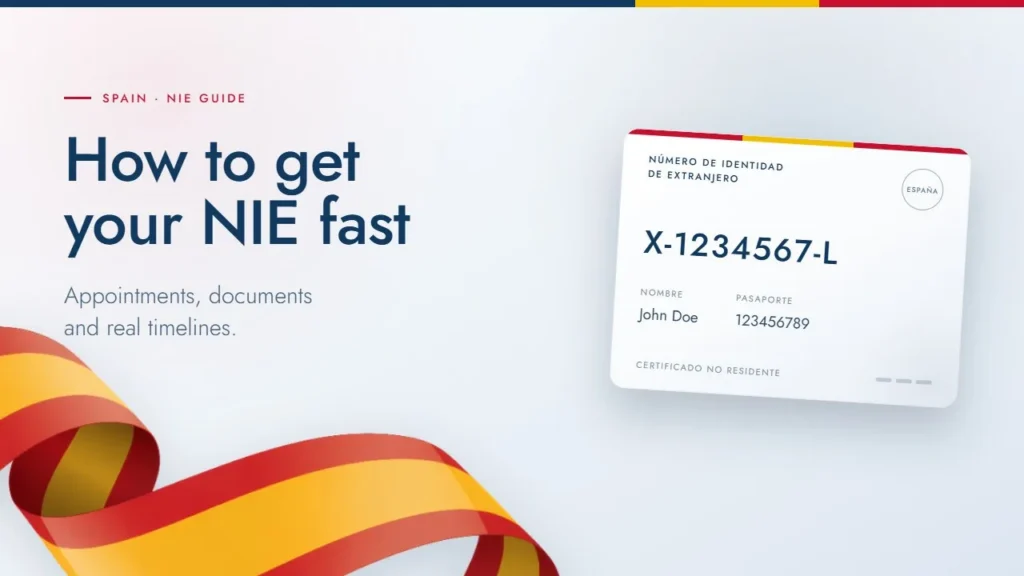
| NIE application | €9.84 + service fee | State fee plus whoever does the legwork. See how to get your NIE. |
| Spanish will | Fixed fee | Strongly recommended for any foreign owner; avoids a slow cross-border inheritance process on a Spanish asset. |
A fee that is far below the market rate usually means part of the work is not being done. Whatever the fee, it should come with a written engagement letter setting out what is included: searches, contracts, completion, tax filings, and what is not.
Five warning signs
The lawyer is paid by the other side
If the developer or seller pays the lawyer’s fee, or the fee is included in the price, the lawyer is not acting for you. Appoint your own.
No colegiado number, or reluctance to give it
Every registered abogado has one. Consultants and unregulated advisers do not, are not required to carry professional insurance, and answer to no regulator when something goes wrong.
Money into a personal account
Deposits and completion funds go through a firm’s client account or directly to the seller at the notary. They never go to an individual’s personal account.
Pressure to sign the arras before the searches
The arras is binding and the deposit is at risk from the moment it is signed. The legal checks come first. Our guide to the arras contract explains why.
No written engagement letter
The letter should set out the scope of work, the fee, what happens if the purchase falls through and who your contact is. Do not pay anything until you have it.
How Foxes works on the legal side
Foxes is an independent Spanish law firm and mortgage broker based near Málaga, working with international clients since 2015. Our lawyers are registered abogados and our mortgage brokerage is registered with the Bank of Spain, D470. We act for buyers and sellers only. Because the legal and mortgage teams work together, the lawyer knows what the bank will require and the mortgage adviser knows what the legal checks have found.
Buying or selling in Spain? Talk to a lawyer who acts for you
Registered Spanish abogados, English-speaking, fee agreed in writing before we start. We are paid by you and nobody else in the transaction.
Frequently asked questions
What is a Spanish lawyer called?
An abogado, or abogada for a woman. Lawyers in Spain register with a regional bar association called a Colegio de Abogados and carry a colegiado number. There is no separate solicitor and barrister profession; one abogado does both.
Is a Spanish solicitor the same as an abogado?
Yes. Solicitor, attorney and advocate are all names other countries use for the same profession. In Spain the equivalent is the abogado, and English-speaking firms here use those terms to describe their abogados.
Do I legally need a lawyer to buy property in Spain?
No. The only professional you cannot avoid is the notary, because registering the title requires a public deed signed before one. The notary does not act for either party or check the property, so foreign buyers should appoint an independent abogado.
What is the difference between a gestor and a lawyer in Spain?
A gestor administrativo handles paperwork and filings with public bodies and is regulated for that. A gestor is not an abogado, cannot represent you in court and is not the professional who carries out the due diligence a property purchase needs.
How do I check a lawyer is registered in Spain?
Ask for their colegiado number and colegio, then search their name on the Censo de Letrados run by the Consejo General de la Abogacía Española. The entry should show them as ejerciente, practising.
How much does a Spanish property lawyer cost?
Independent firms working with international buyers commonly charge around 1% of the purchase price plus IVA, with a minimum fee on lower prices. Sales are usually a fixed quote. Always get the scope and fee in a written engagement letter first.
Sources: Consejo General de la Abogacía Española, Censo de Letrados; Consejo General del Notariado; Ley 34/2006 on access to the legal profession; Real Decreto 135/2021, Estatuto General de la Abogacía; Reglamento Notarial art. 126 and 175; Código Penal art. 403. Fee figures are market ranges as at September 2026.