
Last reviewed August 2026
If you are thinking about moving to Spain, healthcare is usually one of the first worries. Will you be looked after as well as you are at home? Will it cost you more? And what do you actually need in place before Spain will grant you residency? Here is how the two systems compare in 2026, in plain English.
Both systems are good. The real difference is speed, and what Spain asks you to have in place first.
Spain ranks 10th in the world and its people live to 84. The NHS is free to everyone from day one; Spanish cover is tied to your situation, and a visa will ask you to prove yours before you arrive.
How does Spanish public healthcare work?
Spain’s public system is the Sistema Nacional de Salud, or SNS. Like the NHS, it is funded through taxation and free at the point of use for those covered, with prescriptions subsidised rather than free. It is run region by region, so the exact experience in Andalucia differs a little from Madrid or Valencia, but the standard is consistently high. Spain ranked 10th in the world in the Numbeo 2026 Health Care Index, and Spaniards live to 84 on average, nearly three years above the OECD average and among the longest lifespans in Europe.
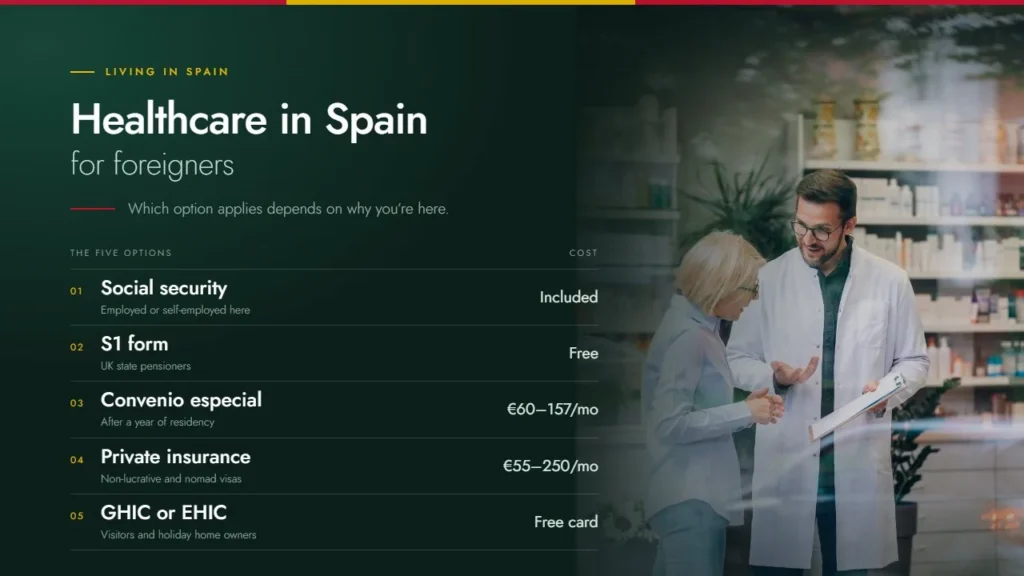
Cover is tied to your situation rather than simply to being present in the country. If you work in Spain, whether employed or self-employed (autonomo, Spain’s equivalent of a sole trader), your social security contributions cover you and your dependants in full.
| Spain | UK | |
|---|---|---|
| Who is covered | Tied to your situation: work, S1, or paying in | Everyone resident, from day one |
| GP appointment | Usually days | Often weeks |
| Prescriptions | Income-based share, capped for most | £9.90 an item in England, free elsewhere |
| Adult dental | Mostly private, cheaper than UK private rates | NHS bands, if you can find a dentist |
| Before you move | A visa may require proof of cover | Nothing to arrange |
Can British pensioners use Spanish healthcare for free?
Yes, and this is one of the most underrated benefits of retiring to Spain. If you receive the UK State Pension, you can apply for an S1 form through NHS Overseas Healthcare Services. Once you register it with the Spanish social security office (the INSS), the UK funds your Spanish public healthcare and you are treated like any Spanish patient. This survived Brexit under the Withdrawal Agreement and remains fully in place in 2026. Spouses and dependants are usually covered too.
If you move before state pension age, you will not qualify for an S1 yet, which is where the next two options come in.
What is the convenio especial?
The convenio especial is Spain’s official pay-in scheme for the public system. After 12 months registered on the padron (the town hall register of residents), you can buy into full public healthcare for around 60 euros a month if you are under 65, or around 157 euros a month if you are 65 or over. Crucially, it accepts pre-existing conditions, which private insurers often exclude. Prescriptions are not included, and each family member needs their own agreement, but for many early retirees it is the bridge between arriving in Spain and their S1 kicking in.
Do you need private health insurance in Spain?
For many movers, yes, at least at first. Spain’s main residency visas, including the non-lucrative visa, require a full-cover private policy from a Spanish-authorised insurer with no copayments or excesses. You cannot use a travel policy or the convenio especial to get the visa granted.
The good news is that Spanish private cover is far cheaper than most people expect. In 2026, a typical policy costs around 50 to 200 euros a month depending on your age and the level of cover; visa-compliant policies generally run from about 600 to 4,500 euros a year per person, with age the biggest factor. Many residents keep a modest private policy alongside their public cover simply to skip queues and choose their specialist, something that would cost several times more in the UK.
One thing to know for short visits before you move: the UK GHIC (the successor to the EHIC) still covers medically necessary state treatment in Spain if you fall ill on a trip. It does not cover planned treatment or private clinics, and it is not a substitute for travel insurance.
How do waiting times compare with the NHS?
Neither system is queue-free, and it is only fair to say Spain’s public waits have grown. At the end of 2025, around 853,000 patients were on the Spanish surgical waiting list, with an average wait of about 121 days for an operation and roughly 102 days for a first specialist appointment, though this varies a lot by region and specialty.
In England, the NHS waiting list stood at 7.28 million in May 2026. There has been real progress, including hitting the interim 18-week target in spring 2026, but around 100,000 people were still waiting over a year for treatment. Spain’s public waits, while real, remain shorter for most routine care, and private cover in Spain is affordable enough that many residents use it precisely to avoid the queues, with private specialist appointments often available within days.
What does day-to-day healthcare cost in each country?
In England, prescriptions cost 9.90 pounds per item in 2026/27 (they are free in Scotland, Wales and Northern Ireland), and NHS dental care is charged in bands. Spain charges a share of the price based on your income rather than a flat fee, and that system was reformed on 14 May 2026: six income bands instead of three, with monthly caps for anyone earning under 35,000 euros. GP and hospital care are free at the point of use for those covered. Routine dentistry sits largely outside the Spanish public system, so most people pay privately for it, though prices are generally lower than UK private rates. How the Spanish pharmacy and prescription system works in practice, including what you pay in each situation, is in our guide to pharmacies and prescriptions in Spain.
| Your income | Workers pay | Monthly cap |
|---|---|---|
| Under €9,000 | 40% | €8.23 |
| €9,000 to €18,000 | 40% | €18.52 |
| €18,000 to €35,000 | 45% | €61.75 |
| €35,000 to €60,000 | 45% | No cap |
| Over €60,000 | 50 to 60% | No cap |
What is different about the culture of care?
One difference that surprises British families: in Spanish hospitals, relatives are expected to be present far more. Family members commonly stay overnight or pop in during the day to help with non-medical care such as washing and meals. It reflects a culture built around family, and most people come to see it as a strength. The flip side is that formal in-home care options are thinner on the ground than in the UK, something worth planning for if you are moving in later life.
So, which is better?
Both are strong universal systems, and both have pressures. The honest summary for 2026: Spain offers excellent public healthcare with generally shorter waits, exceptional value private cover, and clear routes in for Brits, via work, the S1 for pensioners, or the convenio especial. The NHS remains free at the point of use and is improving its backlog, but the queue is still measured in millions.
For most people moving to Spain, the practical question is not “which is better” but “what do I need in place for my visa, and when can I switch to public cover”. That is exactly the kind of thing we help clients sequence every week.
Working out what the move actually costs?
Start with the mortgage. Put your own numbers in and see the borrowing, the monthly payment and the cash you need to complete.
Planning a move to Spain?
Foxes is a finance and legal team based near Malaga, Bank of Spain registered (D470), helping international buyers across Spain with mortgages, conveyancing, NIE numbers and residency since 2015. If you want to talk through healthcare requirements for your visa alongside the property side, book a free consultation and we will walk you through it.
See what a Spanish bank would actually lend you
The calculator gives you the estimate. The application gives you the answer, checked against real lender criteria by the team that would handle your case.
This article is general information, not medical or immigration advice. Rules and prices change; always confirm current requirements before you apply. Last reviewed August 2026.