
Last reviewed August 2026
Which option you get depends on one thing: why you are in Spain.
Working here puts you in the public system through your contributions. A UK state pension brings an S1. Living here without working means private cover first, and the pay-in scheme after a year. Visiting means your GHIC and a travel policy. They are not interchangeable, and the pay-in scheme most people ask about is not available in your first year.
Spain’s public healthcare is good, and most people who move here end up glad of it. The catch is getting in. What you are entitled to depends on your circumstances rather than on simply living here, so it is best to find out which option suits your situation.
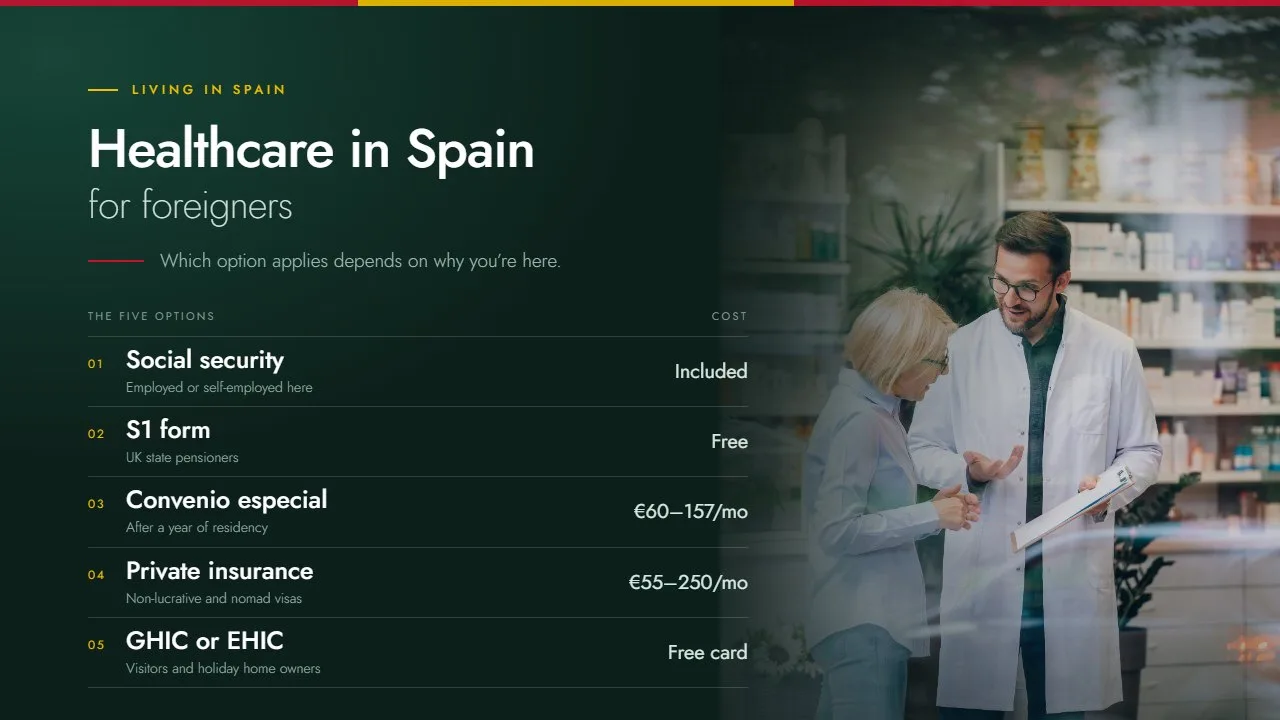
The five options compared
| Option | Who it is for | What it costs | What you get |
|---|---|---|---|
| Social security | Employed or self-employed in Spain | Included | Full public cover, family included |
| S1 | UK state pensioners | Free | Full public cover, dependants included |
| Convenio especial | Residents with a year here and no other cover | €60 to €157/mo | Public cover, prescriptions excluded |
| Private insurance | Non-lucrative and nomad visas, or anyone wanting speed | €55 to €250/mo | Fast access, English-speaking clinics |
| GHIC or EHIC | Visitors and holiday home owners | Free card | Necessary state treatment only |
If you work here, employed or self-employed
If you work in Spain legally, you are covered. Your social security contributions cover you and your family for full public healthcare, free at the point of use, with nothing to buy on top. Self-employed people pay the monthly autonomo contribution, which includes healthcare, so a freelancer is covered on exactly the same terms as an employee.
If you are a UK state pensioner
The S1 is the best deal available to a Briton in Spain, and plenty of people arrive not knowing it exists. The UK pays Spain for your healthcare, you are treated on the same terms as a Spanish citizen, and it covers dependants too.
One hard limit: you must already be receiving your UK state pension. Early retirees living on savings or a private pension do not qualify.
We compare the two systems properly, including how the waiting lists actually stack up, in Spanish healthcare versus the NHS.
If you are living here without working
This is the non-lucrative and digital nomad option, and it runs in two stages.
Year one: private cover, and it has to be the right kind
A visa application needs a policy from a Spanish authorised insurer, with no co-payments and no waiting periods. The cheaper tier with a co-payment will not be accepted at the consulate, so check before you buy.
| Your age | Roughly what to budget |
|---|---|
| 35 | €55 to €85 a month |
| 45 | €70 to €115 a month |
| 55 | €100 to €160 a month |
| 65 | €150 to €250 a month |
| 70 | €230 to €400 a month |
After a year: the convenio especial
Once you have completed a full year of legal residency you can pay into the public system directly, at 60 euros a month under 65 and 157 over 65. It is administered regionally, so you apply through your own health service.
If you are only visiting, or you own a holiday home
Your GHIC, the card that replaced the EHIC for Britons, covers medically necessary state treatment while you are here, on the same basis as a local. It does not cover repatriation, private hospitals, or a flight home with a broken leg, so it is not a substitute for travel insurance.
Owning a property in Spain changes nothing about this. A holiday home does not give you residency or a health card, and visits still sit inside the 90 days in any 180 that Britons get. We set out what that limit really means in our guide to the 90/180 rule.
How to actually get registered
Empadronamiento
Register at your town hall as living at your address. Almost everything else asks for this first, and it is the step people delay.
Register the option that applies to you
Employed or self-employed: your social security number. Pensioner: register the S1 with the INSS. Convenio especial: apply through your regional health service once your year is up.
Health card
Take the paperwork to your local centro de salud and ask for the tarjeta sanitaria. Some regions call it something else, the SIP in Valencia for instance.
You are assigned a GP
At your nearest centro de salud, and you can ask to change if you would rather see someone who speaks English.
Download your region health app
Appointments, prescriptions and test results run through it, and it saves you queueing at 8am for a ticket. How prescriptions work once you have the card.
What the public system does not cover
Adult dental beyond extractions and emergencies, glasses, and a share of every prescription. Workers pay 40 to 60% of the price of a public prescription depending on income, with monthly caps for those earning under 35,000 euros, and pensioners pay 10% with a cap of between 8.23 and 18.52 euros a month. The convenio especial does not subsidise medicine at all, so on it you pay full price. How prescriptions work at the pharmacy, what you pay in each situation and what to do with the medication you already take is covered in our guide to pharmacies and prescriptions in Spain.
One change worth watching, not planning around
There is a decree in progress that would widen public access to people who genuinely live in Spain without formal residency, proven by things like your padron, a rental contract or utility bills. It is not in force. It is still going through approval, and each region would apply it in its own way. It is worth knowing about, but not something to rely on when you plan your move.
Buying a home here, and healthcare
They are separate questions, and one does not unlock the other. You do not need residency, a health card or a Spanish address to buy a property in Spain or to get a Spanish mortgage as a non-resident. Equally, buying does not put you in the health system.
If you are moving rather than holidaying, budget the cover alongside the mortgage. At 55 you would budget around 100 to 160 euros a month for private cover, which is worth building into your figures alongside the mortgage.
Working out what the move actually costs?
Start with the mortgage. Put your own numbers in and see the borrowing, the monthly payment and the cash you need to complete.
Common questions
Is healthcare free in Spain?
Free at the point of use if you contribute through work, hold an S1, or pay into the convenio especial. It is not free to arrive and use.
Can I use my GHIC if I own a house in Spain?
Yes, as a visitor, for medically necessary state treatment. Owning property does not change your status or replace travel insurance.
Do I need private insurance for a Spanish visa?
For the non-lucrative and digital nomad visas, yes, from a Spanish authorised insurer with no co-payments and no waiting periods. A UK state pensioner with an S1 does not need it.
How much is private health insurance in Spain?
Roughly 55 to 85 euros a month at 35, 100 to 160 at 55, and 230 to 400 at 70, for the no-copay tier that visas require.
What is the convenio especial and when can I use it?
A scheme that lets residents pay into the public system, 60 euros a month under 65 and 157 over 65, once you have completed a full year of legal residency. Prescriptions are not included.
Do prescriptions cost anything?
Yes. Since 14 May 2026 workers pay 40 to 60% by income band, with monthly caps for anyone earning under 35,000 euros, and pensioners pay 10% with caps between 8.23 and 18.52 euros a month.
See what a Spanish bank would actually lend you
The calculator gives you the estimate. The application gives you the answer, checked against real lender criteria by the team that would handle your case.
This article is general information about healthcare access in Spain, not medical, immigration or insurance advice. Rules are applied regionally and change, so check the current position with your regional health service or a qualified adviser. Foxes is a Spanish mortgage and legal firm registered with the Bank of Spain, registration D470.