
If you are a UK citizen who loves spending time in Spain, you will know the limit well: 90 days in any 180, counted across the whole Schengen area, and now recorded digitally at the border, so the days genuinely count. We cover how the 90/180 rule works in a separate guide.
This one is about the other half of the question, the half that matters if Spain has stopped being just a holiday: what are your options if 90 days is not enough? There are real routes, they are used successfully by thousands of Brits every year, and they each suit a different situation. Here they are, honestly, with what each one requires in 2026, including the route that no longer exists and that some websites are still selling.
The short answer, before the detail: there are two main routes.
- The non-lucrative visa: if you have at least 2,400 euros a month of passive income, such as a pension. No working allowed.
- The digital nomad visa: if you earn around 2,800 euros a month working remotely for an employer or clients outside Spain.
Neither requires buying property, and buying property gets you neither.
First, what changed at the border?
Two things worth knowing before choosing a route.
The EU’s Entry/Exit System (EES) finished rolling out in April 2026, so passports are no longer stamped by hand: entries and exits are recorded digitally, with fingerprints and a photo. The days when an overstay might slip through unnoticed are over, and overstaying can cost you future entry, so the routes below are not optional paperwork, they are the game.
ETIAS, the travel authorisation Brits will need for short visits (similar to an American ESTA), is expected to follow but is not running yet: at the time of writing there is no confirmed start date and you cannot apply for one. If a website is offering to sell you an ETIAS today, it is not official; the only place to get one, when it launches, will be the EU’s own site.
Neither of these changes the 90/180 rule itself. They just enforce it properly.
The non-lucrative visa: for retirees and anyone living on passive income
The NLV is the classic route for retirees and the most used long-stay visa among Brits. It gives you residency in Spain for a year, renewable, on one core condition: you can support yourself without working.
What you need in 2026:
- Passive income of at least 2,400 euros a month (28,800 euros a year)
- Plus 600 euros a month for each family member coming with you
- The income must be genuinely passive: pensions, rental income, investments (a salary does not count)
- No working allowed, including remote work for a UK employer
- Full private health insurance with no co-payments
- A clean criminal record certificate
- You apply from the UK through the Spanish consulate, not from inside Spain
- The first permit runs a year, then renews in two-year blocks
One point consulates increasingly press on: they want to see that you have genuinely stopped working, not just that you have savings in an account.
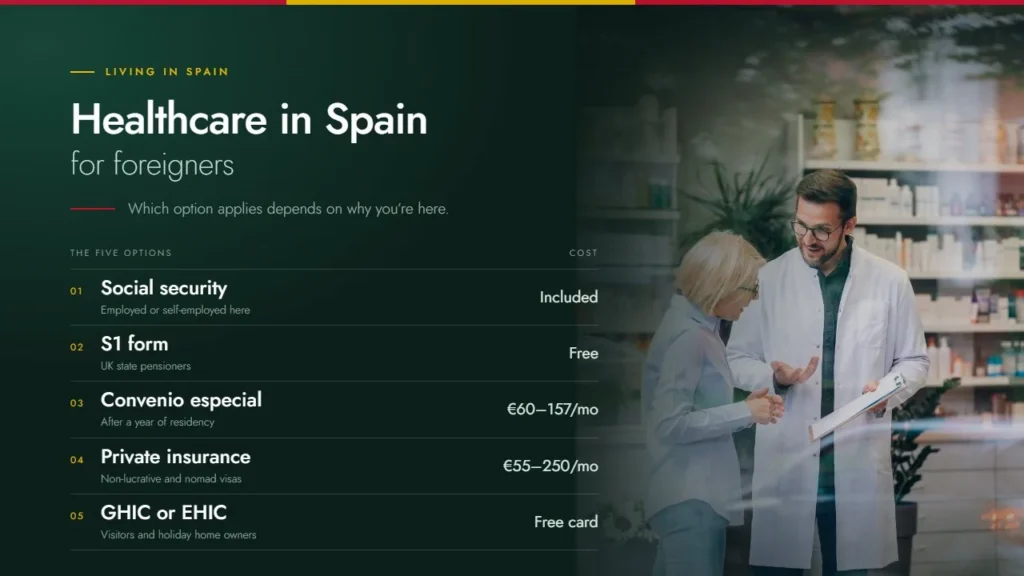
A money-saving note for state pensioners: if you receive the UK state pension, the S1 form generally covers the healthcare requirement instead of paying for private insurance, which saves a retired couple a meaningful sum every year. Confirm it with your consulate when you apply, as practice varies.
On timing, allow two to three months from application to visa through the consulate, and start gathering documents well before that; the criminal record certificate and apostilles are usually the slow part.
Right for: retirees, and anyone whose money arrives without working for it.
Wrong for: anyone planning to work remotely on the quiet. That is what the next visa is for, legally.
The digital nomad visa: for remote workers
Spain’s digital nomad visa did what the NLV never could: it made working remotely from Spain legal. If you are employed by a UK company or freelance for clients outside Spain, you can live in Spain and keep working.
What you need:
- Remote income of roughly 2,800 euros a month (the threshold tracks Spain’s minimum wage, so it moves slightly each year)
- Your employer or clients must be outside Spain (a UK employer or UK freelance clients are exactly what it is for)
- The employment or client relationship at least three months old, with a company that has traded for a year or more
- Proof you can do the job remotely: a degree or three years’ professional experience
- Private health insurance and a clean criminal record
- Can be applied for from inside Spain, and the initial permission runs up to three years
It also carries possible tax advantages under Spain’s special expat regime, which deserves proper advice of its own.
Right for: anyone with a laptop job and a UK employer willing to put the arrangement in writing.
Wrong for: anyone whose clients or employer would mainly be Spanish; at that point you are working in Spain and need a normal work permit.
Which visa fits you? The two main routes side by side
| Non-lucrative visa | Digital nomad visa | |
|---|---|---|
| Income needed | 2,400 euros a month, passive | Around 2,800 euros a month, from remote work |
| Can you work? | No, not even remotely | Yes, remotely, for non-Spanish employers or clients |
| Where you apply | From the UK, via the consulate | From the UK, or from inside Spain |
| First permit | 1 year, then two-year renewals | Up to 3 years |
| Typical wait | Two to three months | Faster; around 20 working days when applied for inside Spain |
| Right for | Retirees and passive income | Remote workers |
Both roads lead to the same place: after five years of continuous legal residence you can apply for permanent residency, and the clock starts with your first permit.
The golden visa: gone, and be wary of anyone selling it
For years the simplest route for buyers was the golden visa: spend 500,000 euros on Spanish property, get residency. That route ended in April 2025. Buying property in Spain no longer grants any residency rights, at any price. We mention it because outdated articles, and the occasional less scrupulous operator, still dangle it. If someone is selling you residency through property purchase in 2026, walk away.
The good news, covered below: not having residency does not stop you owning, or mortgaging, a Spanish home.
The other routes, briefly
Each of these has its own paperwork, but in outline:
- Student visa: full-time study, including language schools, and a good trial year in Spain at any age
- Work visa: a Spanish employer sponsors you; the sponsorship is the hard part
- Family routes: if your partner is an EU citizen, this is generally simpler than any visa above
The two visas in the previous sections cover the large majority of British cases.
The part nobody mentions: tax residency
Here is the trade that every route above involves, and that most articles skip. Spend more than 183 days a year in Spain and you become a Spanish tax resident, whatever your visa says. That means Spain taxes your worldwide income: your UK pensions, your rental income, your investment gains, all of it, under Spanish rules and rates, with the UK double taxation treaty deciding who taxes what.
For plenty of people the numbers work out fine, and the digital nomad visa’s special expat regime can even improve them. But the visa is the easy part; the tax residency it triggers is the decision that deserves proper advice, taken before you apply rather than in your first Spanish tax return. Whatever you do, do not drift into it by accident by overstaying the rhythm of the 90/180 rule.
What if you are not British?
The 90/180 rule, and every route above, applies to non-EU visitors generally, so if you are American, Canadian or Australian, this article is your situation too: the same limit, the same visas, the same income figures, applied for through the Spanish consulate in your own country. The non-lucrative and digital nomad visas are the workhorses for those nationalities as well.
And if you are an EU citizen, Irish, Dutch, German or otherwise, none of this applies to you at all: freedom of movement means there is no 90-day limit and no visa to arrange, just a residency registration once you settle. The 90-day limit is a non-EU problem.
Do you need any of this to buy a home in Spain?
No, and this surprises people: property ownership and residency are completely separate. You can own a Spanish home, and take a Spanish mortgage as a non-resident, while remaining a UK resident who visits within the 90/180 rule. Thousands of British owners do exactly that, and for a holiday home it is usually the right answer: no visa, no Spanish tax residency, just the rhythm of the rule.
Where the routes above come in is when the holiday home starts becoming the main home. The pattern we see constantly: buy as a non-resident first, spend a couple of years testing real life in Spain inside the 90/180 rule, then apply for the NLV or digital nomad visa when you are sure. The purchase does not have to wait for the visa, and in most cases it should not, since the process is identical either way. Our purchase process guide covers the buying side from offer to keys.
The short version
The 90/180 rule is now digitally enforced, and there are two main ways past it: the non-lucrative visa if you live on passive income (2,400 euros a month, no work allowed), and the digital nomad visa if you work remotely (around 2,800 euros a month). Either way, five years of residency opens the door to permanent residency, and more than 183 days a year makes you a Spanish tax resident, which deserves advice before you apply. The golden visa is gone; ignore anyone selling it. And none of this is needed simply to own or mortgage a Spanish home, which you can do as a non-resident today.
Frequently asked questions
How can a UK citizen stay in Spain longer than 90 days?
By getting a visa or residency permit. The main routes are the non-lucrative visa for those with passive income and the digital nomad visa for remote workers; student, work and family routes cover the rest.
How much income do I need for Spain’s non-lucrative visa?
In 2026, 2,400 euros a month (28,800 euros a year) for the main applicant, plus 600 euros a month per dependant, from passive sources such as pensions or investments. Working, including remotely, is not allowed on this visa.
Can I work remotely for a UK company from Spain?
Legally, yes, on the digital nomad visa: roughly 2,800 euros a month of remote income, an established contract or clients, and proof you can work remotely.
Can I still get Spanish residency by buying property?
No. The golden visa ended in April 2025 and property purchase no longer grants residency at any price. Treat anyone claiming otherwise with caution.
Can I buy a home in Spain without residency?
Yes. Ownership and residency are separate. Non-residents can buy and mortgage Spanish property and visit within the 90/180 rule, which is how most British holiday-home owners do it.
Will I have to pay Spanish tax if I move to Spain?
Once you spend more than 183 days a year in Spain you become a Spanish tax resident and Spain taxes your worldwide income, with the UK treaty preventing double taxation. Take advice on this before applying for any visa, not after.
How long does a Spanish visa application take?
Allow two to three months for the non-lucrative visa through the consulate. The digital nomad visa is usually faster, around 20 working days when applied for from inside Spain.
Thinking about the property side?
See what a Spanish mortgage looks like on your numbers with the mortgage calculator, or check your position in two minutes with our pre-qualification check. On the legal side, our property conveyancing team handles the purchase itself, from contracts to keys. For the full picture, mortgage and legal under one roof, book a free consultation.