
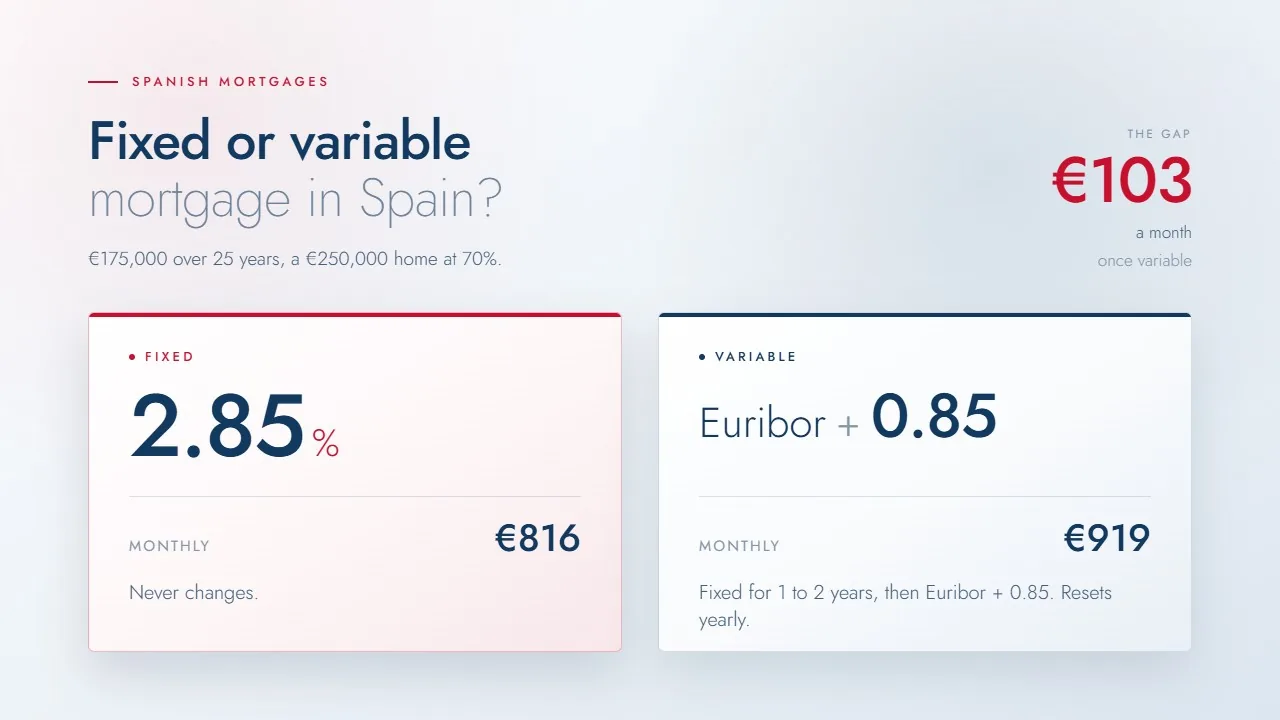

For most international buyers in 2026 the answer is fixed. Spanish banks are pricing a full-term fixed rate below what a variable becomes once its initial fixed period ends, the fee for later moving a variable to a fixed is capped by law (though the move itself is a new application, not a phone call), and a payment that never moves is worth more when your income is in another currency. A variable makes sense if you expect Euribor to fall well below 3% and can absorb the years when it does not. This guide sets out how each product works, the rates we are placing right now, a worked example, and how to change your mind later.
How does a fixed-rate mortgage work in Spain?
The interest rate is agreed on the day you sign and never changes. A twenty-five-year fixed mortgage at 2.85% costs the same in year one as in year twenty-five, whatever the European Central Bank does in between. Spanish fixed rates are true full-term fixes, not the two- or five-year deals a UK buyer will be used to, which is why they are the default choice for someone paying a euro mortgage from a sterling, dollar or dirham salary.
The price of that certainty is a rate set a little above where the bank expects the variable to average. In 2026 that premium has all but disappeared: we are placing full-term fixed rates from 2.85%, while a variable, once its initial period ends, runs at Euribor plus margin, about 3.95% at today’s Euribor. When the fixed is cheaper than the variable it turns into, the bank is telling you it expects Euribor to fall. You have to decide whether you agree, and whether your monthly payment should depend on it.
How does a variable-rate mortgage work in Spain?
A Spanish variable has two phases. For the first twelve or twenty-four months the rate is fixed at a figure the bank sets, so your opening payments do not move. From then on the rate is the 12-month Euribor plus a fixed margin, typically 0.75% to 1.25% for an international buyer, and your payment is recalculated once a year (a few banks do it every six months) against wherever Euribor sits on the review date. Euribor is the rate at which eurozone banks lend to each other for a year, published daily and driven mostly by what the ECB is expected to do next.
Two things a buyer coming from another market often misses. First, the opening fixed period makes the first year or two look calmer than the rest of the term will be; judge a variable on Euribor plus margin, because that is what you will pay for the other twenty-three years. Second, the margin itself is often conditional: banks knock 0.5% to 1% off it if you take their home insurance, life cover, pay your salary into the account and use their card (the lending guide covers what banks look for). These bonificaciones are worth less to a non-resident, who rarely qualifies for the payroll discount, and they lapse if you drop a product.
What is a mixed mortgage?
A fixed rate for an initial period, usually five or ten years, then a variable at Euribor plus a margin for the rest of the term. We see mixed products around 4% for the fixed period and Euribor plus 1.6% after it. That combination is rarely the best of both: you pay more than a full fix during the fixed years and more than a straight variable afterwards. It suits one buyer specifically: someone who intends to sell or repay within the fixed period and wants certainty until then without paying a full-term fixed premium. If that is not you, compare fixed against variable and leave mixed out.
How is a Spanish mortgage repaid? The French system
Every Spanish mortgage, fixed or variable, uses the French amortisation system: a constant monthly payment for the life of the loan, made up of interest on what you still owe plus a slice of capital. Because the balance is largest at the start, the early payments are mostly interest and the late payments are mostly capital. The payment itself does not change; only the mix inside it does.
| Payment | Interest | Capital | Balance after |
|---|---|---|---|
| Month 1 | 416 euros | 401 euros | 174,599 euros |
| Month 60 (year 5) | 355 euros | 461 euros | 149,196 euros |
| Month 120 (year 10) | 285 euros | 531 euros | 119,446 euros |
| Month 180 (year 15) | 204 euros | 613 euros | 85,145 euros |
| Month 240 (year 20) | 110 euros | 706 euros | 45,597 euros |
| Month 300 (year 25) | 2 euros | 814 euros | 0 |
Three things follow from this, and all three bear on the fixed or variable decision. A rate rise on a variable costs most in the early years, when the balance it applies to is still close to the full loan; the same one-point rise in year twenty costs a fraction of that. Early repayment saves most in the early years too, which is why the law lets banks charge more for it then. And on a variable, a payment recalculation does not just change the interest; the bank recomputes the whole schedule on the new rate and the remaining term, so a rise in Euribor lengthens the interest-heavy phase as well as raising the instalment.
Which is cheaper right now?
Our example rates in September 2026, and what they mean on a typical non-resident purchase: a 250,000 euro home, a 175,000 euro mortgage (seventy percent), twenty-five years. Rates are indicative, reviewed by our mortgage team in July 2026, and your bank sets the final terms.
| Product | Rate | Monthly payment | Total interest over 25 years | What can change |
|---|---|---|---|---|
| Fixed | 2.85% | 816 euros | 69,900 euros | Nothing |
| Variable | Bank-set fixed rate for 1 to 2 years, then Euribor 3.1% + 0.85 = 3.95% | 919 euros once variable | 100,700 euros if Euribor stayed at 3.1% | Every year after the opening period, up or down with Euribor |
| Mixed | About 4% fixed, then Euribor + 1.6 | 924 euros | 102,100 euros at 4% throughout | Nothing for 5 to 10 years, then yearly |
The gap is about 100 euros a month once the variable is variable. A variable only wins if Euribor falls far enough, for long enough, to give that back. It was below 0% from 2016 to early 2022 and above 4% in late 2023. Nobody, including the banks, prices twenty-five years of that with confidence.
Where are Spanish mortgage rates heading?
Up, for the moment. The ECB raised its three key rates by a quarter point on 10 September 2026, taking the deposit rate to 2.50% from 16 September, its second increase of the year, citing inflation pressure from the conflict in the Middle East. Twelve-month Euribor had already moved from about 2.7% in early July to about 3.1% by September in anticipation. Variable borrowers whose review date falls in the coming months will see their payment rise; fixed borrowers will not notice.
Whether this is the top is the question the variable buyer is betting on. Economists polled before the meeting expected September to be the last increase in this cycle, but the same people did not expect the cycle at all a year ago. Our rates page carries the live Euribor figure and our current brackets.
Can you switch from variable to fixed later?
You can, but usually not with your own bank. Asking your own bank to convert the loan (a novación) is legal and cheap on paper, and it is a negotiation, not a right: the bank can refuse, and it has no reason to move you off a variable it is happy with onto a fixed it is not. When a bank does agree, the price is usually a bundle: salary paid into the account, its home and life insurance, a fixed rate a little above the market. Expect a no, or a yes conditional on those products.
The route that works is moving the mortgage to another bank, a subrogación. It is a new mortgage application in all but name: the new bank checks your income again, orders a valuation (250 to 500 euros, sometimes paid by the new bank), and issues a FEIN with the same ten-day reflection period (the stages are the same as a first mortgage). Once it has made a binding offer, your current bank has seven days to certify what you owe and fifteen days to match the offer and keep you, which is often the only moment it will give you a decent fixed rate. Allow one to three months end to end. Costs follow the same rules as a new mortgage: the new bank pays the notary, the registry and the gestoría, a subrogación is exempt from stamp duty, and you pay the valuation and the compensation below. Two limits worth knowing before you count on it: you switch at the fixed rate available on the day, not today’s, so if Euribor has risen enough to make you want out, fixed rates will have risen too; and a bank taking on a non-resident’s mortgage applies the same seventy percent loan-to-value cap, so if the property has not gained value you may not be able to move the whole balance.
What the law lets a bank charge
| What you do | Maximum fee by law | After that |
|---|---|---|
| Switch a variable to a fixed rate (same bank or a new one) | 0.05% of the balance in the first three years | Nothing |
| Repay a variable early | 0.25% in the first three years, or 0.15% in the first five; the bank picks one | Nothing |
| Repay a fixed early | 2% in the first ten years | 1.5% |
Early repayment is capped too, and here the fixed is the dearer product: up to 2% of the amount repaid in the first ten years of a fixed and 1.5% after, against 0.25% in the first three years of a variable (or 0.15% in the first five, the bank chooses which) and nothing after. The bank can only charge what it actually loses, so the real figure is often lower, but if you are likely to sell or repay within a few years, that difference belongs in the decision.
Which suits a non-resident buyer?
Which one, in thirty seconds
| If this is you | Then |
|---|---|
| Your income is in pounds, dollars, dirhams, anything but euros | Fixed |
| You will hold the property ten years or more | Fixed |
| You will repay or sell within five years | Variable, the exit fee is lower |
| A 200 euro rise in the monthly payment would go unnoticed in your budget | Variable is possible |
| You believe Euribor will average under 2% for the next twenty-five years | Only then, variable |
Fixed suits you if
Variable suits you if
A broker earns the same whichever you choose, and we place both. In 2026, with the fixed priced under the variable and the switching fee capped, we are recommending fixed to most buyers who ask. If your situation is one of the variable cases above, we will say that too. The rate is one decision inside a longer process; the complete guide to getting a mortgage in Spain covers the rest.
See both payments on your own numbers
The calculator runs fixed and variable side by side on real Spanish bank criteria, with the buying costs included. Pre-qualification takes a few minutes more.
Common questions
Are fixed rates in Spain fixed for the whole mortgage?
Yes. A Spanish fixed rate holds for the full term, twenty or twenty-five years, not for an introductory period. That is the main difference from the UK market, where a fix usually lasts two to five years before reverting.
What is the 12-month Euribor and why does it matter?
It is the rate at which eurozone banks lend to each other for a year, and almost every Spanish variable mortgage is priced as Euribor plus a fixed margin once its opening fixed period of one or two years ends. In September 2026 it is about 3.1%. Your variable payment is recalculated against it once a year.
Do non-residents pay a higher rate than residents?
At most banks, no. The published pricing is the same; the difference for a non-resident is the loan-to-value cap, seventy percent rather than eighty, and fewer of the margin discounts, because you are unlikely to pay a Spanish salary into the account.
How much does it cost to switch a Spanish mortgage from variable to fixed?
The compensation is capped by law at 0.05% of the outstanding balance during the first three years and nothing after that. In practice your own bank rarely agrees to convert, so the switch usually means moving to another bank, which is a new application with a valuation and the ten-day reflection period; the new bank pays the notary, registry and gestoría, you pay the valuation. You switch at the fixed rate available on the day, not the rate you could have had at the start.
What is the early repayment penalty on a Spanish mortgage?
Capped by law: on a fixed rate up to 2% of the amount repaid in the first ten years and 1.5% after; on a variable up to 0.25% in the first three years or 0.15% in the first five, then nothing. The bank may only charge what it actually loses, so the real figure is often lower.
Is a mixed mortgage a good compromise?
Rarely. It costs more than a full fix during the fixed years and more than a variable afterwards. It suits a buyer who will sell or repay within the fixed period and wants certainty until then. For anyone holding long term, compare fixed against variable and leave mixed out.
Why is the fixed rate cheaper than the variable right now?
Because banks expect Euribor to fall over the coming years and price the full-term fixed on that expectation, while a variable, after its opening period, runs on today’s Euribor plus margin after two ECB increases in 2026. It is unusual, and it is the strongest argument for fixing while it lasts.
Foxes is a mortgage and legal company registered with the Bank of Spain as a credit intermediary (D470), working with international buyers across Spain since 2015. Rates quoted are our indicative examples reviewed in July 2026 and the ECB and Euribor figures are as published in September 2026; your bank sets the final terms. Fee caps are from Law 5/2019 on real estate credit contracts.