
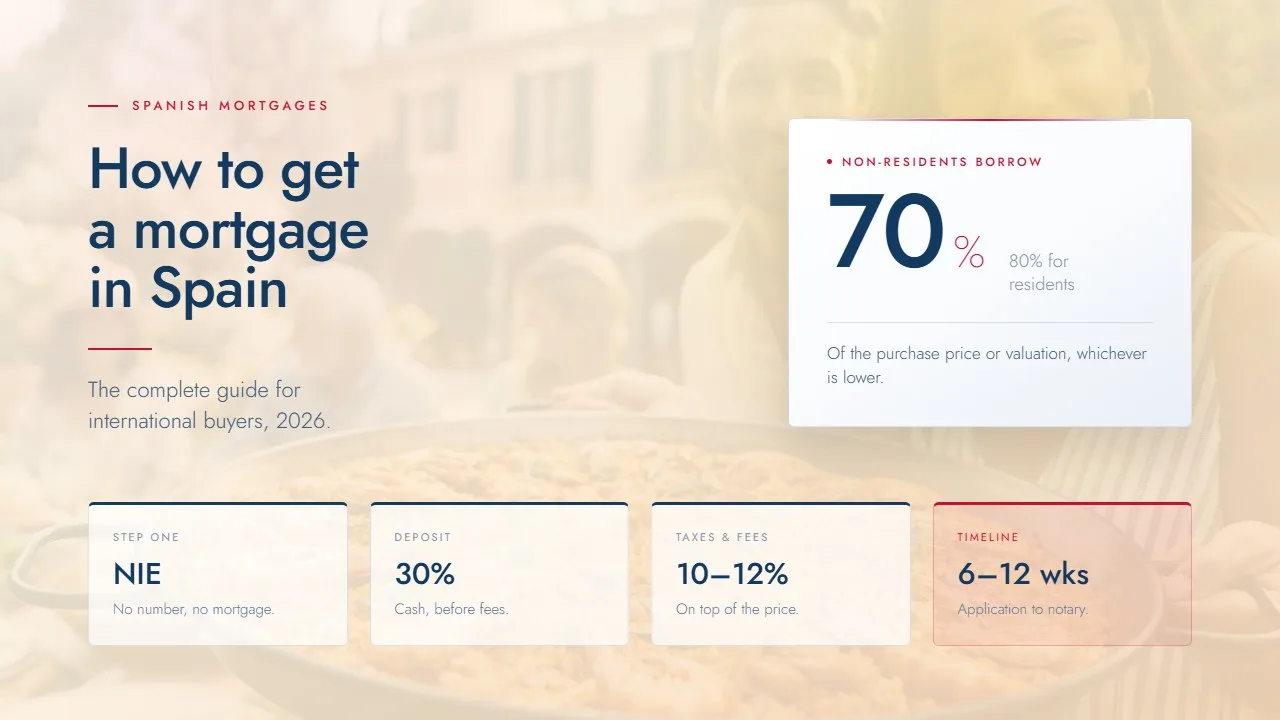

You get a Spanish mortgage from a Spanish bank, secured on the Spanish property, and as a non-resident you can borrow up to seventy percent of the price (eighty percent as a resident), repaid by age seventy-five, at the same published rates residents pay. The process runs in six stages over six to twelve weeks, the paperwork is heavier than at home, and three things decide whether you get a yes: your income after existing debts, your deposit, and your age. This guide covers each stage in order, with links to the detailed articles where you want more.
The whole process at a glance
| Stage | What you do | What you need | How long |
|---|---|---|---|
| 1. Pre-qualify | Check you fit the rules before you view | Income, deposit, age, existing debts | Same day |
| 2. Agreement in principle | Send the full document file to the bank | The document list below, complete | 1 to 2 weeks |
| 3. Offer and valuation | Offer accepted, reserva paid, bank books the valuer | A property, and access for the valuer | 1 to 2 weeks |
| 4. Binding offer (FEIN) | Bank’s risk department approves and issues the FEIN | The valuation report | Days to 1 week |
| 5. Reflection period | Review with your lawyer, notary session | NIE, Spanish bank account, power of attorney if you are abroad | 10 days by law |
| 6. Signing | Mortgage and purchase deeds signed together | Deposit and costs in the Spanish account | 1 day |
Can you get a mortgage in Spain as a foreigner?
Yes. Spanish banks lend to non-residents from most countries; roughly one purchase in five in Spain is by a foreign buyer, and the large banks run international desks for them. You do not need residency, a Spanish job or a Spanish credit history. You do need a NIE (the tax identification number for foreigners), a Spanish bank account before completion, and the ability to prove your income in a form a Spanish underwriter can read. Nationality changes the paperwork, not the answer: an American buyer adds FATCA forms and a US credit report, a Gulf buyer proves income without a tax return, a UK buyer since 2021 is treated as a non-EU non-resident. More on who qualifies, and the country guides for the UK, United States, Ireland, Netherlands and UAE and Gulf.
How much can you borrow?
Two limits apply and the lower result is what you can borrow. The first is loan-to-value: a Spanish bank lends against the lower of the purchase price and its own valuation, up to seventy percent for a non-resident and eighty percent for a resident. Some banks quote sixty percent for non-residents; seventy is the working figure for most nationalities and we check each bank’s current position before you apply. The second is affordability: your total monthly debt payments, including the new mortgage and anything you already pay at home, must stay under about forty percent of your net monthly income, and banks apply a discount to income earned in a currency other than the euro.
| Non-resident | Spanish tax resident | |
|---|---|---|
| Maximum loan-to-value | 70% of the lower of price and valuation | 80% |
| Minimum deposit | 30% plus buying costs | 20% plus buying costs |
| Buying costs on top | 10 to 12% of the price, not financed by the bank | |
| Debt-to-income ceiling | About 40% of net monthly income, all debts included | |
| Maximum age at the end of the term | 75, so a 55-year-old gets 20 years, a 50-year-old 25 | |
| Typical term | 20 to 25 years | Up to 30 |
| Minimum loan | Around 100,000 euros at most international desks | |
What it looks like on a 250,000 euro home
| Non-resident | Resident | |
|---|---|---|
| Purchase price | 250,000 euros | 250,000 euros |
| Mortgage | 175,000 euros (70%) | 200,000 euros (80%) |
| Deposit | 75,000 euros | 50,000 euros |
| Taxes and fees (about 11%) | 27,500 euros | 27,500 euros |
| Cash needed to complete | 102,500 euros | 77,500 euros |
| Monthly payment, 3.15% fixed, 25 years | 844 euros | 964 euros |
| Net monthly income needed at the 40% ceiling, no other debts | 2,110 euros | 2,410 euros |
What does a Spanish mortgage cost?
Spanish rates are set in two ways. A fixed rate holds for the whole term, twenty or twenty-five years, not for an introductory period. A variable is fixed by the bank for the first one or two years, then runs at the 12-month Euribor plus a margin, reset once a year. Non-residents are offered the same published rates as residents at most banks; the difference is the loan-to-value cap, not the price.
We are placing fixed rates from 3.15% in 2026 (reviewed October 2026); a variable at Euribor plus 0.85 runs at about 4.10% at the September 2026 Euribor average once its opening period ends. On the worked example below that is 844 euros a month fixed against 933 variable. Fixed or variable, and which suits a non-resident, and the current rates and Euribor.
Who pays what
| Cost | Who pays | Typical amount |
|---|---|---|
| Notary, land registry, gestoría, stamp duty on the mortgage deed | The bank, since the 2019 mortgage law | Nothing to you |
| Valuation (tasación) | You | 300 to 600 euros |
| Arrangement fee | You, if the bank charges one | Many international desks do not; where they do, 0.5% to 1% |
| Your copy of the deed | You | A few hundred euros |
| Buildings insurance | You, required for the life of the loan | 300 to 600 euros a year on an apartment, more for a villa |
| Life cover | You, most banks ask for it | Depends on age and loan size |
| Purchase taxes and fees on the property | You, whether you borrow or not | 10 to 12% of the price |
What documents does a Spanish bank ask for?
More than a bank at home, and much the same list from every bank. Send it complete in one go; a file that arrives in pieces goes to the back of the queue each time, and incomplete paperwork is the most common reason a mortgage takes twelve weeks instead of six.
| Document | Notes |
|---|---|
| Passport | Every applicant |
| NIE | Or proof you have applied; you cannot sign the mortgage deed without it. How to get it |
| Proof of income | Last three payslips and employment contract, or two years of accounts and tax returns if self-employed |
| Last tax return | From your home country, the full return |
| Bank statements | Three to six months, the account your salary lands in and the account holding the deposit |
| Credit report | From your home country: Experian or Equifax in the UK, a bureau report in the US, and so on |
| Existing mortgage statements | Every property you already own, with balance and monthly payment |
| Proof of deposit | Where it is now and, if it came from a gift or a sale, where it came from |
| Property details | Once you have one: the nota simple, the price and the agent’s details, so the valuation can be booked |
You will also need a Spanish bank account, for the mortgage payments to leave from and for the purchase funds to land in, and some banks want it open before final approval. Opening one as a non-resident takes a passport, the NIE and proof of address, usually the same day at a branch or through your broker. It does not have to be at the lending bank, though the lender will usually want the mortgage paid from an account it holds.
How does the process work, and how long does it take?
Six stages, six to twelve weeks from a complete application to signing at the notary. The stages themselves add up to five or six weeks of work; the calendar is longer because the purchase runs alongside and every handover waits on someone. The order of the last three is fixed by law.
Pre-qualification, same day
A read of your income, deposit and age against the rules above, before you view anything. Ours takes a few minutes online and does not touch your credit file.
Documents and agreement in principle, one to two weeks
With the file above complete, the bank gives an agreement in principle on amount and rate, subject to the valuation. You can do this before you have a property, and it lets you make an offer knowing what you can borrow.
Valuation, one to two weeks
Once you have an accepted offer, the bank instructs a valuer registered with the Bank of Spain. You pay for it; it is valid for six months; the bank lends against the lower of price and valuation.
Final approval and the FEIN, a few days to a week
The bank’s risk department gives final approval and issues the FEIN, the European Standardised Information Sheet, with the FiAE warnings sheet. The FEIN is a binding offer: rate, fees, schedule and every condition, which the bank cannot change while it is valid.
Reflection period, ten days by law
Spanish law requires at least ten calendar days between receiving the FEIN and signing (fourteen in Catalonia). In that window you, or your lawyer under power of attorney, visit the notary for a free session confirming you have received and understood the documents.
Signing and funds, one day
The mortgage deed and the purchase deed are normally signed at the same notary appointment. The loan is drawn, the seller is paid, the keys change hands.
On a new build the clock runs differently: the bank lends on the finished property, so the mortgage is applied for in the months before completion, and on an off-plan purchase no bank releases funds until the licence of first occupation is issued. Get the agreement in principle when you reserve, then run the rest in the final two months. The full timeline, with a dated worked example, the new-build case and what slows a file down.
How do you line the mortgage up with the purchase?
The Spanish purchase has its own clock. You reserve with a small holding deposit, then sign the contrato de arras and pay around ten percent, with completion typically six to twelve weeks later. If the mortgage is not ready on that date and the contract has no protection, the seller can keep the deposit. Two things prevent it: get the agreement in principle before you make an offer, so the only stages left are the valuation, the FEIN and the ten days; and have your lawyer write a financing condition into the arras, returning the deposit if the mortgage is refused or not issued in time. The purchase process, step by step, and the 36 Spanish words you will hear along the way.
Buying as a couple, with a partner, or through a company
A joint application counts both incomes and both sets of debts, and the age limit is usually worked from the older applicant, so a couple with one high earner and one older partner can borrow less than the earner alone. Anyone on the deed normally has to be on the mortgage, and the other way round, so a partner who contributes to the deposit but not to the mortgage needs the arrangement written into the deed by your lawyer. Buying through a company, Spanish or foreign, is possible but banks lend less, typically fifty to sixty percent, want personal guarantees from the shareholders, and take longer; it makes sense for investment portfolios and rarely for a single home. How non-resident lending works.
Broker or bank?
You can apply direct to a Spanish bank, and for a resident with a Spanish salary that is often fine. For a non-resident a broker saves time in four places: the file goes in complete the first time, several banks are approached at once rather than one after another, the valuation, bank account and notary are sequenced with your lawyer, and if one bank refuses another already has the file. A broker does not shorten the ten days or the valuation. In Spain a mortgage broker must be registered with the Bank of Spain as a credit intermediary; ours is D470, and you can check any broker on the Bank’s public register before sending them a document. What a Spanish mortgage broker does and costs.
What gets an application refused?
Usually one of five things, and each has a fix if you know before you apply. Credit history matters less than at home because Spanish banks cannot see your foreign file directly, but they will ask for it, and a recent default or an undisclosed debt that appears on it is a refusal.
| Reason | What the bank sees | The fix |
|---|---|---|
| Affordability | Existing debts plus the new payment over 40% of net income | Repay a loan first, lengthen the term, or borrow less |
| Income it cannot read | Cash, undeclared, too recent, or self-employed with one year of accounts | Two years of accounts and tax returns; an accountant’s one-page summary |
| Deposit without a trail | Money that arrived without a documented source | Statements showing the sale, the savings history or the gift letter |
| Age | The term needed for an affordable payment runs past 75 | Shorter term with a bigger deposit, or a younger co-applicant |
| Credit file | A default or an undisclosed debt on your home-country report | Disclose everything up front; see bad credit and how checks work |
See what you could borrow before you start
The calculator gives you the borrowing, the monthly payment and the cash you need to complete, on real Spanish bank criteria. Pre-qualification takes a few minutes more and does not touch your credit file.
Common questions
How do I get a mortgage in Spain as a non-resident?
Apply to a Spanish bank, directly or through a registered broker, with your passport, NIE, proof of income, tax return, bank statements, credit report and proof of deposit. The bank lends up to seventy percent of the lower of price and valuation, at the same rates residents pay, repaid by age seventy-five. Allow six to twelve weeks from a complete application to signing.
How much deposit do I need for a Spanish mortgage?
Thirty percent of the price as a non-resident, twenty percent as a resident, plus 10 to 12% of the price for taxes and fees, which no bank will finance. On a 250,000 euro home a non-resident needs about 102,000 euros in cash.
Do I need a NIE to get a mortgage in Spain?
Yes. You cannot sign a mortgage deed, or a purchase deed, without one. You can start the application while the NIE is pending, but apply for it the week you decide to buy; appointments can take weeks in busy provinces.
Can I get a Spanish mortgage before I find a property?
You can get an agreement in principle on the amount and rate from your documents alone. Final approval and the binding offer need the valuation, so they wait for an accepted offer. Doing the first part early saves more time than anything else in the process.
Do non-residents pay higher mortgage rates in Spain?
At most banks, no. The published pricing is the same; what changes for a non-resident is the loan-to-value cap, seventy percent rather than eighty, and fewer of the margin discounts that depend on paying a Spanish salary into the account.
What is the maximum age for a Spanish mortgage?
Most banks require the loan to be repaid by age seventy-five, and want you under about sixty-five at the start. Your age therefore sets your maximum term: a fifty-five-year-old gets twenty years, a sixty-year-old fifteen. With a joint application banks usually work from the older applicant.
Do I have to be in Spain to sign the mortgage?
No. A power of attorney granted to your lawyer lets them attend the notary for the reflection-period session and for signing. Many non-resident buyers complete without a second trip.
Who pays the mortgage costs in Spain?
Since the 2019 mortgage law the bank pays the notary, the land registry, the gestoría and the stamp duty on the mortgage deed. You pay the valuation, any arrangement fee and your copy of the deed. Purchase taxes and fees on the property itself are separate and are yours.
Foxes is a mortgage and legal company registered with the Bank of Spain as a credit intermediary (D470), working with international buyers across Spain since 2015. Lending limits and timescales are what we see in practice in 2026; rates quoted are our indicative examples reviewed in October 2026; the legal rules are from Law 5/2019 on real estate credit contracts. Your bank sets the final terms.