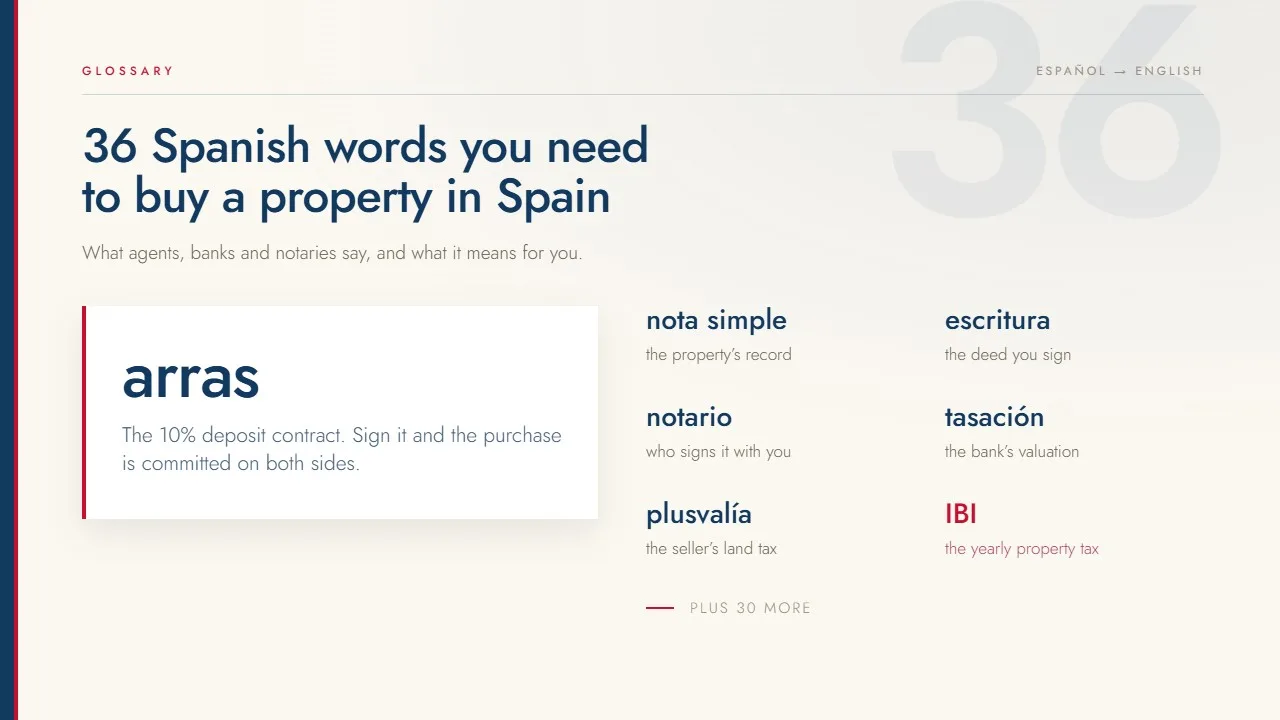

You do not need to speak Spanish to buy a property here, but 36 words come up in every purchase, from the first listing you read to the first tax return you file, and most of them have no exact English equivalent. Agents, banks and notaries use them without translating. This is what each one means, why it matters to you, and where it appears in the process.
The 36 words at a glance
In the order you meet them, with a rough pronunciation (capitals show the stressed syllable). Tap a word to jump to it.
| # | Word | Meaning | Say it |
|---|---|---|---|
| 1 | Piso / Apartamento | Flat | PEE-so, a-par-ta-MEN-to |
| 2 | Ático | Top floor flat, usually with a terrace | AH-tee-ko |
| 3 | Adosado | Terraced or townhouse | a-do-SAH-do |
| 4 | Chalet / Villa | Detached house | cha-LEH, BEE-ya |
| 5 | Finca | Country property, or any registered property | FEEN-ka |
| 6 | Urbanización | Housing development or estate | oor-ba-nee-tha-thee-ON |
| 7 | Obra nueva / Segunda mano | New build / Resale | OH-bra NWEH-ba, seh-GOON-da MAH-no |
| 8 | Metros construidos / útiles | Built / usable square metres | MEH-tros kons-troo-EE-dos, OO-tee-les |
| 9 | NIE | Foreigner’s identification number | NEE-eh |
| 10 | Abogado | Lawyer | ah-bo-GAH-doh |
| 11 | Gestor | Administrative agent | hes-TOR |
| 12 | Notario | Notary | no-TAH-ree-oh |
| 13 | Nota simple | Land Registry extract | NO-tah SEEM-pleh |
| 14 | Catastro | Cadastre, the tax map of the property | ka-TAS-tro |
| 15 | Cargas | Charges or debts on the property | KAR-gas |
| 16 | Licencia de primera ocupación | First occupation licence | lee-THEN-thee-a deh pree-MEH-ra o-koo-pa-thee-ON |
| 17 | Cédula de habitabilidad | Habitability certificate | THEH-doo-la deh a-bee-ta-bee-lee-DAD |
| 18 | Certificado energético | Energy performance certificate | ther-tee-fee-KAH-do eh-nehr-HEH-tee-ko |
| 19 | Reserva | Reservation contract | reh-SEHR-bah |
| 20 | Arras | Deposit contract | AH-rras |
| 21 | Contrato privado | Private purchase contract | kon-TRAH-to pree-BAH-do |
| 22 | Poder notarial | Power of attorney | po-DEHR no-ta-ree-AL |
| 23 | Hipoteca | Mortgage | ee-po-TEH-ka |
| 24 | Tasación | Bank valuation | ta-sa-thee-ON |
| 25 | FEIN | The binding mortgage offer document | FAYN |
| 26 | Subrogación | Taking over an existing mortgage | soo-bro-ga-thee-ON |
| 27 | Escritura | Title deed | es-kree-TOO-ra |
| 28 | Registro de la Propiedad | Land Registry | reh-HEES-tro deh la pro-pee-eh-DAD |
| 29 | ITP | Transfer tax on resale property | ee-teh-PEH |
| 30 | IVA and AJD | VAT and documented legal acts tax, the stamp duty on new builds | EE-ba, ah-HO-ta-DEH |
| 31 | Suministros | Utilities | soo-mee-NEES-tros |
| 32 | Plusvalía | Town hall tax on the land value increase | ploos-ba-LEE-a |
| 33 | IBI | Annual property tax | EE-bee |
| 34 | Comunidad | Owners’ association and its fees | ko-moo-nee-DAD |
| 35 | Modelo 210 | Non-resident annual tax return | mo-DEH-lo dos-thee-EN-tos DYETH |
| 36 | Vivienda habitual | Main home | bee-BYEN-da a-bee-TWAL |
Reading the listings
Piso / Apartamento
Flat
Both mean flat. Piso is the everyday word for a flat in a block, and apartamento tends to be used for something smaller or for a holiday flat, although agents use the two loosely. Estudio is a studio. Planta is the floor, so a piso en planta tercera is on the third floor, counted the Spanish way from a ground floor that is not the first. Check whether the price includes a garage space, plaza de garaje, and a storeroom, trastero, because they are often sold as separate registered units.
Ático
Top floor flat, usually with a terrace
A top-floor flat, normally with a large terrace, and priced accordingly. Its opposite is the bajo, the ground-floor flat, which is cheaper and often comes with a private patio or garden. Between them are the pisos. An ático with a roof terrace is where you check hardest that the terrace is registered as part of the flat rather than a shared roof the community has let someone use.
Adosado
Terraced or townhouse
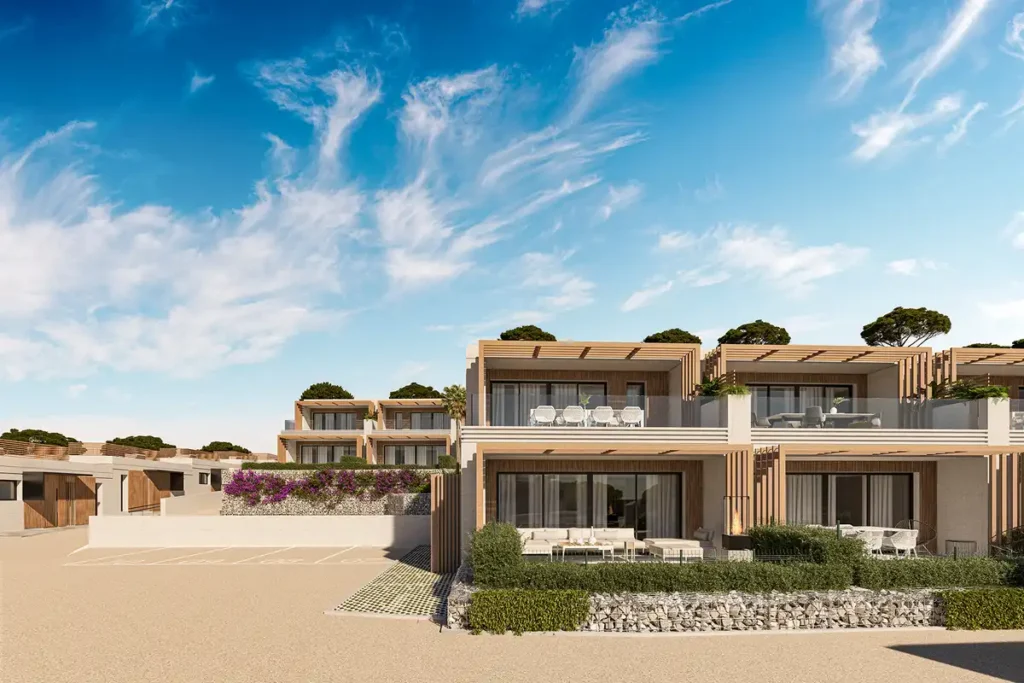
A townhouse: a house that shares one or both side walls with its neighbours, usually in a row inside an urbanización, often with a small garden and a shared pool. Pareado means semi-detached, sharing one wall. Adosados are almost always run by a comunidad, so the fees and the rules about what you can change on the outside come with the house.
Chalet / Villa
Detached house
Chalet is the ordinary Spanish word for a detached house with its own plot, nothing to do with the Alps; villa is what agents call the same thing when selling to foreigners, and you will see both on the same listing. Chalet independiente means fully detached, chalet pareado semi-detached. With a chalet the questions move from the building to the plot: whether the boundaries on the ground match the Catastro, whether the pool and any extension have a licence, and whether the land is urban.
Finca
Country property, or any registered property
In a listing a finca is a rural property, a country house with land, sometimes called finca rústica or cortijo. In the Land Registry the same word means any registered property, so your lawyer will talk about the finca registral of a city flat too. A finca rústica sits on rural land, suelo rústico, where building is heavily restricted and many existing houses were built without permission, which is why the DAFO exists. The plot itself is the parcela; a parcela urbana can be built on, a parcela rústica in most cases cannot.
Urbanización
Housing development or estate
A housing development or residential estate, from a gated complex of flats to a whole hillside of villas. Most run as a comunidad with fees for the shared roads, gardens, pool and security. Some older ones were never handed over to the town hall, so the owners also pay for the streets and lighting through an entidad de conservación. Ask which it is before you offer.
Obra nueva / Segunda mano
New build / Resale
New build and resale, and the split decides your taxes. Buying obra nueva from the developer means IVA and AJD; buying segunda mano, anything that has had an owner before, means ITP. Sobre plano is off plan, bought before it is built, where your stage payments must by law be guaranteed by a bank guarantee or insurance policy that your lawyer checks exists before you pay a euro.
Metros construidos / útiles
Built / usable square metres
Spanish listings quote built square metres, which include the walls and often a share of the common areas, marked con zonas comunes. The usable area, metros útiles, is the floor you can actually walk on and is usually 10% to 20% smaller. The registered size on the nota simple and the size on the Catastro are two more numbers, and it is normal for all four to differ. Your lawyer checks the registered ones; you compare the useful ones.
Before you start
NIE
Foreigner’s identification number
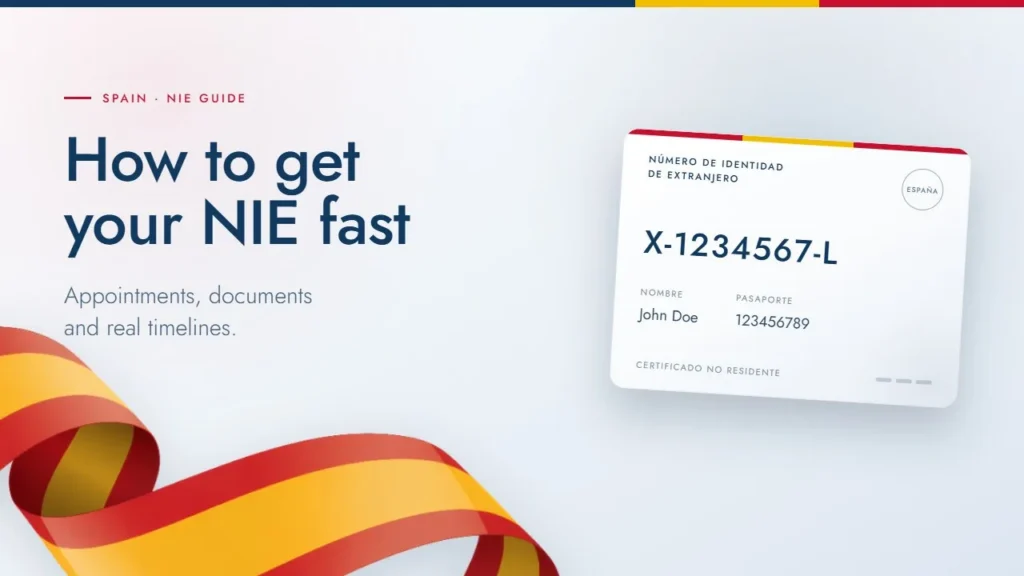
Número de Identidad de Extranjero, the tax identification number every foreigner needs to do almost anything official in Spain. You cannot sign an arras, open a bank account, take a mortgage or complete a purchase without one. It is a number, not a residency permit, and it never expires. Getting the appointment is the slow part; our guide covers the four ways to do it: how to get your NIE fast.
Abogado
Lawyer
A lawyer. Whatever your country calls them, solicitor, attorney or advocate, the Spanish equivalent for property work is the abogado, who advises, drafts and represents. The abogado you want is independent, registered with a Colegio de Abogados, and paid by you alone. The notary is not your lawyer, the agent is not on your side, and a gestor handles paperwork rather than legal checks, so the abogado is the person who checks the property and the contracts for you. Who does what in a Spanish property deal explains the roles.
Gestor
Administrative agent
The paperwork professional. A gestor administrativo queues at government offices for a living: NIE appointments, tax filings, registering a car, changing the utilities into your name. Useful and cheap, but a gestor does not give legal advice and does not check a property, and some estate agents call their in-house gestor a lawyer. For the purchase itself you want an abogado; after completion a gestor can handle the annual filings.
Notario
Notary
The notary is a public official, a lawyer by training but neutral by law. The notary checks that everyone signing is who they say they are, that the property matches the Land Registry, that the price and payment are recorded correctly, and then sends the deed to the registry and reports the sale to the tax office. What the notary does not do is act for you or check whether the extension has a licence. Every purchase completes in front of one; fees are set by a state tariff and by custom are usually paid by the buyer, although the Civil Code splits them unless the contract says otherwise.
Checking the property
Nota simple
Land Registry extract
The extract from the Land Registry for a specific property. It shows the registered owner, the registered description and size, and any cargas. It costs a few euros online and your lawyer pulls a fresh one at the start of due diligence and again on the morning of completion. If the nota simple does not match what you are being sold, that is the first problem to solve.
Catastro
Cadastre, the tax map of the property
The Cadastre, the state’s map and register of every plot and building, used for tax. Each property has a referencia catastral and a valor catastral, the cadastral value used to calculate IBI and plusvalía. The Catastro and the Land Registry are separate systems and do not always agree; a mismatch between them and the actual building is one of the commonest things a lawyer has to fix before you buy.
Cargas
Charges or debts on the property
Charges: anything registered against the property that follows it to the new owner. A mortgage, an embargo from an unpaid debt, a right of way, a lien. A property sold libre de cargas is free of them. Unpaid community fees and IBI are not on the nota simple but also follow the property, which is why the community certificate and the last IBI receipt are demanded at completion.
Licencia de primera ocupación
First occupation licence
The first occupation licence, issued by the town hall when a new building is finished and matches the approved plans. In Cataluña, Baleares and several other regions the separate cédula de habitabilidad, covered below, is needed as well. In Andalucía the licence is not legally required to sell, but a bank will usually ask for it before lending, and its absence tells your lawyer to look harder at how the property was built. For older unlicensed builds, most often in the Andalusian countryside, the related document is the DAFO, which records the building as tolerated because the infringement is out of time; it does not legalise it, but it allows utilities and maintenance.
Cédula de habitabilidad
Habitability certificate
A certificate that a home meets the minimum standards to be lived in. It is separate from the first occupation licence and is required in Cataluña, Baleares and several other regions, where a seller must produce a valid one to sell and you need it to connect water and electricity. It expires, 15 years for an existing home in Cataluña, so an old one may need renewing before completion. In Andalucía there is no cédula; the licence does the job.
Certificado energético
Energy performance certificate
The energy performance certificate, rated A to G, that a seller must have before advertising a property and must hand you at the notary. It is valid for ten years, five for a G rating. It tells you very little about a Spanish home, since most sit at E or below, but its absence on completion day is a fine for the seller and a delay for you, so your lawyer asks for it early.
Reserving and committing
Reserva
Reservation contract
The reservation contract. When your offer is accepted you pay a small deposit, typically a few thousand euros, and the property comes off the market for two to four weeks while your lawyer does the checks. The reservation counts towards the price. What it says about getting the deposit back if the checks find a problem is the clause to read.
Arras
Deposit contract
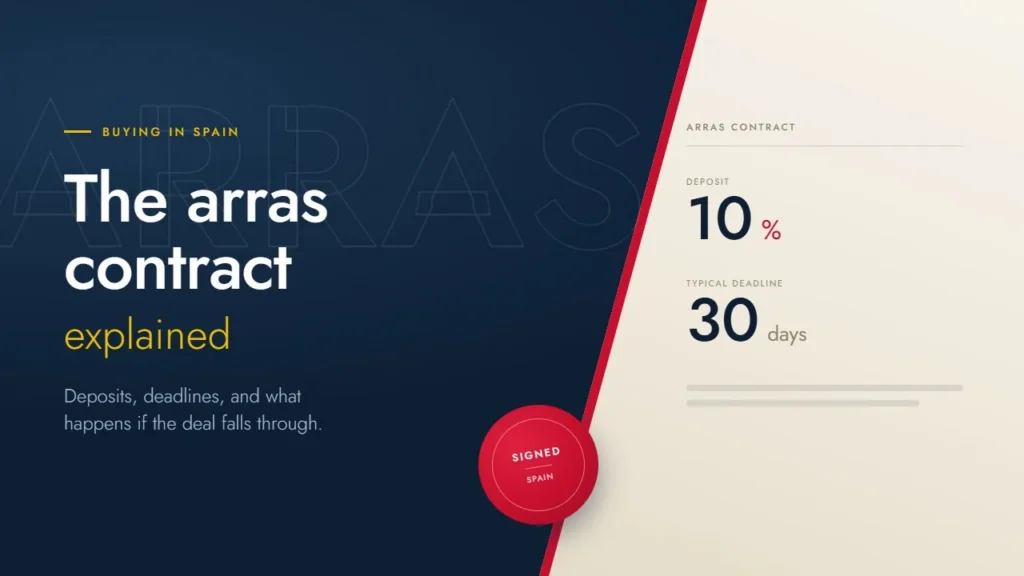
The contrato de arras, the private contract that binds both sides to the sale. You pay a deposit, normally 10% including the reservation, and both parties commit to a completion date. Under arras penitenciales, the usual type, a buyer who pulls out loses the deposit and a seller who pulls out returns it doubled. It is the most important document you sign before the deed. The arras contract explained.
Contrato privado
Private purchase contract
Any contract signed between buyer and seller without a notary. The arras is the usual private contract on a resale. On a new build the developer’s contrato privado de compraventa is the one you sign, often with a schedule of stage payments running to completion. It binds both sides but cannot be registered, so nothing is yours until the escritura; that is why the payments in it must be guaranteed and why you read it with a lawyer, not just sign it.
Poder notarial
Power of attorney
A power of attorney, signed before a notary, which lets your lawyer sign the arras, the mortgage and the deed for you. It means you do not have to be in Spain for completion. Sign it at a Spanish notary while you are here, at a Spanish consulate, or at a notary at home with an apostille and a sworn translation.
The mortgage
Hipoteca
Mortgage
Mortgage. Spanish banks lend to non-residents, up to 70% of the lower of price and valuation (80% for Spanish tax residents), over terms of up to 25 or 30 years, repaid by age 75. The word also appears on the nota simple of a property whose seller still has one: the buyer pays the seller’s bank directly at completion and the old hipoteca is then cancelled at the Land Registry with a separate deed, at the seller’s cost. How to get a mortgage in Spain, and the calculator for real numbers.
Tasación
Bank valuation
The bank’s valuation of the property, carried out by a valuation company approved by the Bank of Spain and paid for by you, usually a few hundred euros. The bank lends against the tasación or the price, whichever is lower, so a low valuation means a bigger deposit. It is also the first professional look at the property, and valuers note unregistered extensions.
FEIN
The binding mortgage offer document
Ficha Europea de Información Normalizada, the standardised binding offer the bank must give you before you sign a mortgage. It sets out the rate, the fees, the linked products and the total cost, and by law you get ten calendar days to read it before you can sign, with a visit to the notary in between to confirm you understood it. If a bank rushes you past the FEIN, something is wrong.
Subrogación
Taking over an existing mortgage
Stepping into someone else’s mortgage. On a new build the developer often offers the buyer subrogation of its own loan on the unit, which saves the set-up costs but ties you to that bank’s terms, so compare it against a fresh offer. On a resale you can in theory take over the seller’s mortgage with the bank’s consent, though most sellers simply repay it at completion. The same word covers moving your own mortgage to another bank later; Spanish law caps the fee for doing so.
Completion
Escritura
Title deed
The escritura de compraventa is the title deed, signed by buyer and seller in front of the notary on completion day. The balance of the price changes hands, the keys change hands, and from that moment the property is yours. The notary keeps the original and you receive an authorised copy; the deed then goes to the Land Registry to be recorded in your name.
Registro de la Propiedad
Land Registry
The Land Registry. Registration of the escritura is what makes your ownership public and protects you against later claims, and it is what a bank needs to register its mortgage. It takes from a few weeks to a couple of months after completion, because the transfer tax has to be paid first. Until then the notary’s authorised copy of the deed is your proof of purchase.
ITP
Transfer tax on resale property
Impuesto sobre Transmisiones Patrimoniales, the transfer tax paid by the buyer of a resale property. It is set by each region: 6% to 10% for most purchases, with higher bands on expensive property in Cataluña, Baleares and Valencia, and a flat 7% in Andalucía. The filing deadline is also regional, two months in Andalucía, and your lawyer files it. This is the biggest single cost of buying, so budget for it before you make an offer.
IVA and AJD
VAT and documented legal acts tax, the stamp duty on new builds
On a new build bought from the developer you pay IVA, Spanish VAT, at 10% instead of ITP (7% IGIC in the Canary Islands), plus AJD, Actos Jurídicos Documentados, a stamp duty of 0.5% to 1.5% depending on the region, 1.2% in Andalucía. AJD is also charged on a mortgage deed, but since November 2018 the bank pays that part, not you.
Suministros
Utilities
Utilities: electricity, water, gas, and the contracts behind them. After completion each one is transferred into your name, a cambio de titularidad, which needs a copy of the escritura, your NIE and a Spanish bank account for the direct debit. Your lawyer or a gestor does it. A property that has been disconnected for years may need a new electrical certificate before power is restored, which is a question to ask before you buy, not after.
Owning
Plusvalía
Town hall tax on the land value increase
Plusvalía municipal, the town hall’s tax on the increase in the land value while the seller owned the property. It is the seller’s tax, not yours, but when the seller is non-resident the law makes the buyer the substitute taxpayer, so your lawyer will retain the estimated amount at completion and pay it. When you come to sell, it will be yours. Selling property in Spain covers how it is calculated.
IBI
Annual property tax
Impuesto sobre Bienes Inmuebles, the annual property tax paid to the town hall, based on the cadastral value. A few hundred euros a year for an apartment, more for a villa. Legally the owner on 1 January pays the whole year; in practice the deed splits it by days. The last receipt is demanded at completion as proof there are no arrears.
Comunidad
Owners’ association and its fees
The comunidad de propietarios is the owners’ association that runs the shared parts of a building or housing development: pool, lifts, gardens, insurance. Every owner pays a cuota, the monthly or quarterly fee. Arrears follow the property for the current year and the three before, so a certificate from the community, issued by the secretary or administrator and signed off by the president, that nothing is owed is required at completion. Read the minutes of the last meetings too; planned works mean a special levy.
Modelo 210
Non-resident annual tax return
The tax return every non-resident owner files each year, even with no rental income. Spain taxes you on a notional benefit from owning the property, calculated from the cadastral value, at 19% for residents of the EU and EEA and 24% for everyone else. If you rent the property out, the rental income is declared on the same form. It is a small bill and a very common one to miss; a gestor or your lawyer files it for a modest fee.
Vivienda habitual
Main home
Your main home for tax purposes, which in Spain means you live in it and are tax resident here. It matters because many regions cut ITP for a vivienda habitual, usually with age or price conditions, banks lend a higher percentage on one, and when you sell, the gain can be exempt if you reinvest it in another main home or are over 65. A holiday home is a segunda residencia and gets none of this, so if you plan to move to Spain, tell your lawyer and your broker before you buy.
Save the list
All 36 words in one block, for your notes or your phone. Copy it, or select the text and save it wherever you keep things.
Piso / Apartamento: Flat (PEE-so, a-par-ta-MEN-to)
Ático: Top floor flat, usually with a terrace (AH-tee-ko)
Adosado: Terraced or townhouse (a-do-SAH-do)
Chalet / Villa: Detached house (cha-LEH, BEE-ya)
Finca: Country property, or any registered property (FEEN-ka)
Urbanización: Housing development or estate (oor-ba-nee-tha-thee-ON)
Obra nueva / Segunda mano: New build / Resale (OH-bra NWEH-ba, seh-GOON-da MAH-no)
Metros construidos / útiles: Built / usable square metres (MEH-tros kons-troo-EE-dos, OO-tee-les)
NIE: Foreigner's identification number (NEE-eh)
Abogado: Lawyer (ah-bo-GAH-doh)
Gestor: Administrative agent (hes-TOR)
Notario: Notary (no-TAH-ree-oh)
Nota simple: Land Registry extract (NO-tah SEEM-pleh)
Catastro: Cadastre, the tax map of the property (ka-TAS-tro)
Cargas: Charges or debts on the property (KAR-gas)
Licencia de primera ocupación: First occupation licence (lee-THEN-thee-a deh pree-MEH-ra o-koo-pa-thee-ON)
Cédula de habitabilidad: Habitability certificate (THEH-doo-la deh a-bee-ta-bee-lee-DAD)
Certificado energético: Energy performance certificate (ther-tee-fee-KAH-do eh-nehr-HEH-tee-ko)
Reserva: Reservation contract (reh-SEHR-bah)
Arras: Deposit contract (AH-rras)
Contrato privado: Private purchase contract (kon-TRAH-to pree-BAH-do)
Poder notarial: Power of attorney (po-DEHR no-ta-ree-AL)
Hipoteca: Mortgage (ee-po-TEH-ka)
Tasación: Bank valuation (ta-sa-thee-ON)
FEIN: The binding mortgage offer document (FAYN)
Subrogación: Taking over an existing mortgage (soo-bro-ga-thee-ON)
Escritura: Title deed (es-kree-TOO-ra)
Registro de la Propiedad: Land Registry (reh-HEES-tro deh la pro-pee-eh-DAD)
ITP: Transfer tax on resale property (ee-teh-PEH)
IVA and AJD: VAT and documented legal acts tax, the stamp duty on new builds (EE-ba, ah-HO-ta-DEH)
Suministros: Utilities (soo-mee-NEES-tros)
Plusvalía: Town hall tax on the land value increase (ploos-ba-LEE-a)
IBI: Annual property tax (EE-bee)
Comunidad: Owners' association and its fees (ko-moo-nee-DAD)
Modelo 210: Non-resident annual tax return (mo-DEH-lo dos-thee-EN-tos DYETH)
Vivienda habitual: Main home (bee-BYEN-da a-bee-TWAL)
Source: foxes.es/spanish-property-words/
What comes next
Each of these words has a longer story, and several already have their own guide on this site: the NIE, the arras, the lawyer’s role and selling. The rest, completion day at the notary, the nota simple and Catastro, buying costs by region, the power of attorney and the first occupation licence, are the guides we are writing next. If you would rather have someone read the Spanish for you, that is the job.
Buying in Spain? We read the Spanish so you do not have to
Independent English-speaking Spanish lawyers checking the property and the contracts for you, from reservation to registration. Mortgage brokerage registered with the Bank of Spain, D470.
Frequently asked questions
Do I need to speak Spanish to buy a property in Spain?
No. Contracts are in Spanish and the notary reads the deed in Spanish, but an English-speaking lawyer translates and explains everything you sign, and the notary will use an interpreter or accept your lawyer’s translation. Knowing the words above means you follow the conversation.
What is the difference between arras and reserva?
The reserva is a small holding deposit that takes the property off the market for a few weeks while checks are done. The arras is the binding contract that follows, with a deposit of around 10%, that commits both sides to complete.
What is an escritura?
The title deed, signed before a notary on completion day. It transfers ownership and is then registered at the Land Registry in your name.
What is the difference between ITP and IVA when buying in Spain?
ITP is the transfer tax on a resale property, set by the region, 7% in Andalucía. IVA is VAT at 10% on a new build bought from the developer, paid together with AJD stamp duty. You pay one or the other on the purchase, never both.
What does libre de cargas mean?
Free of charges: no mortgage, embargo or other registered debt attached to the property. It is the state a property should be in when you complete, and the nota simple on the morning of completion is how your lawyer confirms it.
Sources: Ley 5/2019 on mortgage contracts (FEIN, ten-day reflection) and Real Decreto-ley 17/2018 (AJD on the loan paid by the lender); Ley Hipotecaria and Reglamento Notarial; regional ITP and AJD rates as published for 2026 (Andalucía 7% and 1.2%); Ley de Propiedad Horizontal art. 9 on community arrears.