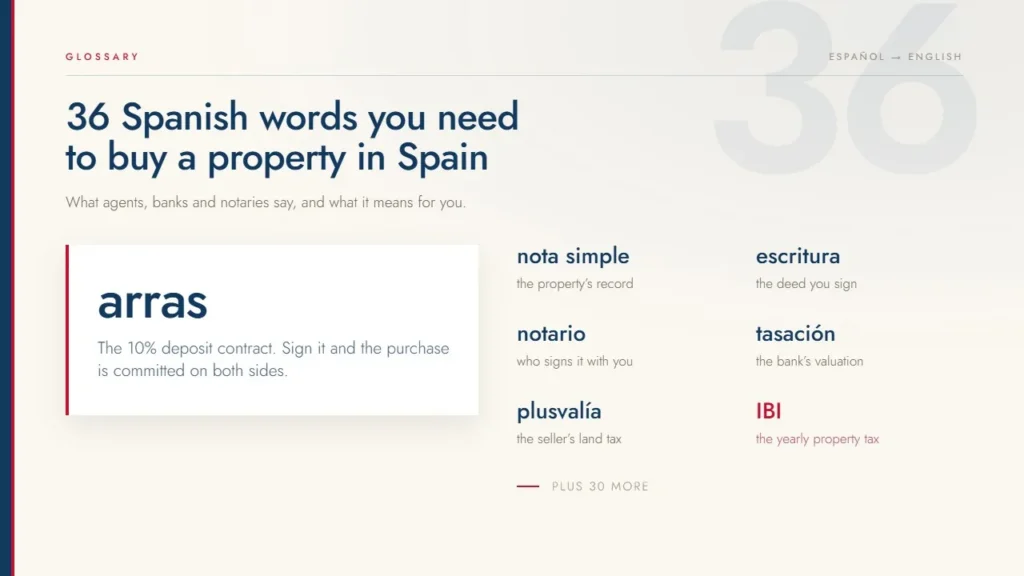

If you are buying a property in Spain, at some point you will hear the word “arras” and be told it involves ten percent of the price. Understandably, that gets people’s attention. It is one of 36 Spanish words every buyer meets; this article is about the most important of them.
Here is the reassuring part: the arras is a completely normal step in every Spanish purchase, it comes later in the process than most buyers think, and by the time you sign it you should already know your purchase is solid. This guide explains how the deposits actually work, in the order they actually happen, written by the legal team at Foxes, a Spanish mortgage and legal firm registered with the Bank of Spain (D470). We handle this sequence for clients every week, and done properly it is smooth.
How do deposits actually work when buying in Spain?
Not the way most articles describe it. In practice there are two stages, and they do different jobs.
First comes the reservation. When your offer is accepted, you pay a reservation deposit, typically around 3,000 euros, and the property comes off the market. This is how you secure the property while the real work happens: nobody sensibly hands over ten percent of the price on day one.
Then comes the groundwork. With the property reserved, your lawyer runs the legal checks and your mortgage gets properly underway. This is the stage where you find out everything you need to know before committing serious money.
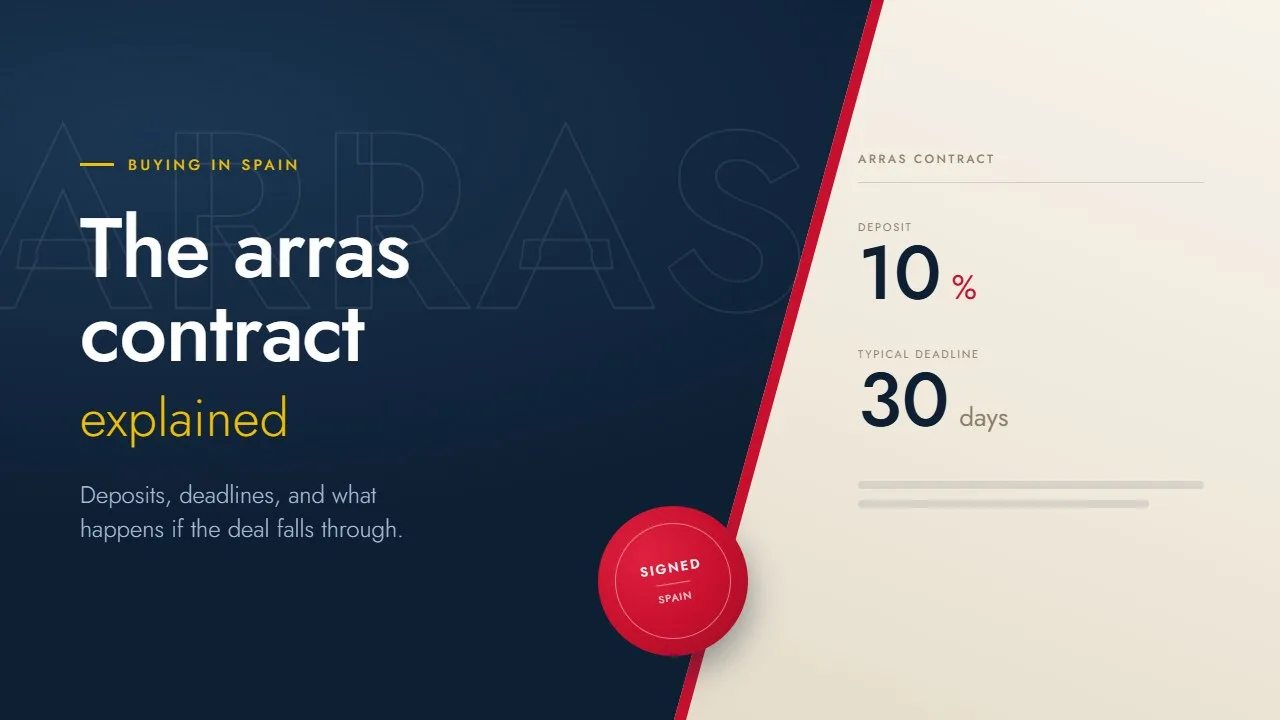
Then comes the arras. Once the checks are clean and your mortgage is in place, you sign the contrato de arras and pay the deposit, usually ten percent of the price. This is the real commitment, made at the point where you actually know what you are committing to. The reservation you paid earlier is not lost: like the arras deposit, it counts towards the purchase price, so everything you have paid comes off the balance due at completion.
And finally completion, when you sign the public deed at the notary, pay the balance and get the keys, typically a few weeks later.
That order is the whole secret. The arras is not a leap of faith taken at the start; it is the confident step taken once the homework is done.
What is the arras contract?
It is the agreement that makes the deal binding on both sides. Signed directly between you and the seller, usually arranged through the agent or the lawyers, it pins down the property, the price, the completion date and what happens if either side fails to complete.
It is also where the important decisions live: when you get the keys, who pays which costs, what has to happen before the notary date. By the time you reach the notary, everything has already been agreed here, which is why completion day itself is usually the easy part.
What happens if someone pulls out?
The standard Spanish arrangement is refreshingly symmetrical. If you walk away after signing the arras, the seller keeps your deposit. If the seller walks away, perhaps because a higher offer appeared, they do not simply return your money: they must pay you double.
On a 300,000 euro purchase, a seller who changes their mind owes you 60,000 euros. That is your protection, and it works: sellers very rarely walk away from a signed arras, because changing their mind is expensive. Both sides are locked in, which is exactly what you want by this stage. (Selling rather than buying? The arras works the same way from the other side; our guide to selling property in Spain covers it.)
This walk-away version has a name, arras penitenciales, and it comes straight from the Spanish Civil Code. When people talk about “the arras”, this is what they mean.
Is there anything to watch out for?
Two things, and both are easy to get right with your lawyer beside you.
The first is the wording. The walk-away arrangement, deposit lost one way, doubled the other, has to be clearly written into the contract. Spanish law recognises other kinds of deposit agreement, and vague wording can leave you with a contract that does not say what everyone at the table assumed. It is a drafting point your lawyer checks in minutes, and fixing it before signature is trivial.
The second is timing your mortgage. You will sometimes read about financing clauses that return your deposit if the bank declines you. In reality, sellers almost never accept one: from their side it turns a firm sale back into a maybe, and in practice it is rare to see one in an arras contract. So do not count on a clause to protect you. Your protection is the sequence itself: the arras gets signed when your finance is in place, not before. Because Foxes handles the mortgage and the legal work under one roof, that timing is managed as standard: we do not let clients commit ten percent on finance a lender has not assessed.
If you are earlier in the journey and want to know what a bank will say, two minutes on our mortgage calculator or the pre-qualification check will tell you, long before any deposit is on the table.
What does the lawyer check before the arras?
This is what the reservation stage is for, and it is where your lawyer earns their fee. Before you commit the ten percent, they confirm the seller owns the property and is free to sell it, that no debts or charges are attached that could become yours, that the property is legally what the listing says it is, that community fees and local taxes are paid up, and that the completion date works for your mortgage timeline.
Then the contract itself: the walk-away wording, who holds the deposit, and what happens in each “what if”. None of it slows a good purchase down; it just means that when you sign, you know exactly what you are signing. Our conveyancing service covers all of it, and the purchase process guide shows the full journey from offer to keys.
Can I negotiate the terms?
Yes, more than most buyers realise. The ten percent is custom, not law: smaller deposits are agreed regularly, especially on higher value properties. The completion date, the conditions and who holds the money are negotiable too, and the reservation stage is your window to negotiate them, because once the arras is signed, the contract is the contract.
The short version
Reservation first, property off the market. Checks and mortgage next, before the main deposit is committed. Arras once everything is solid, and completion at the notary after that. Keep to that order, get the wording checked, and the arras stops being the scary part of buying in Spain and becomes what it should be: the moment your purchase is locked in on terms you understand.
Frequently asked questions
What is a contrato de arras?
The binding deposit agreement in a Spanish property purchase, signed once your checks and mortgage are in place. It fixes the price and completion date and sets what happens if either side fails to complete.
Is the arras the same as the reservation deposit?
No. The reservation is a payment of typically around 3,000 euros that takes the property off the market while your lawyer does the checks and your mortgage progresses. The arras comes after, with the main deposit. Both payments count towards the purchase price at completion.
How much is the arras deposit?
Usually ten percent of the price, though it is negotiable and smaller deposits are common on higher value properties.
Can I get my arras deposit back?
If the seller withdraws, yes, doubled. If you withdraw, the deposit is lost, and that includes your mortgage falling through, which is why the arras should only be signed once your finance is in place.
What happens if the seller pulls out?
Under the standard walk-away arras they must pay you double the deposit, which is why sellers very rarely do it.
Should a lawyer review the arras before I sign?
Yes. It is a binding contract and your protections are the ones written into it. The review happens during the reservation stage, before serious money moves.
Ready when you are
Know where you stand before any deposit is on the table: run the Spanish mortgage calculator or take the two minute pre-qualification check. Want the legal side handled from reservation to keys? Book a free consultation with our team.