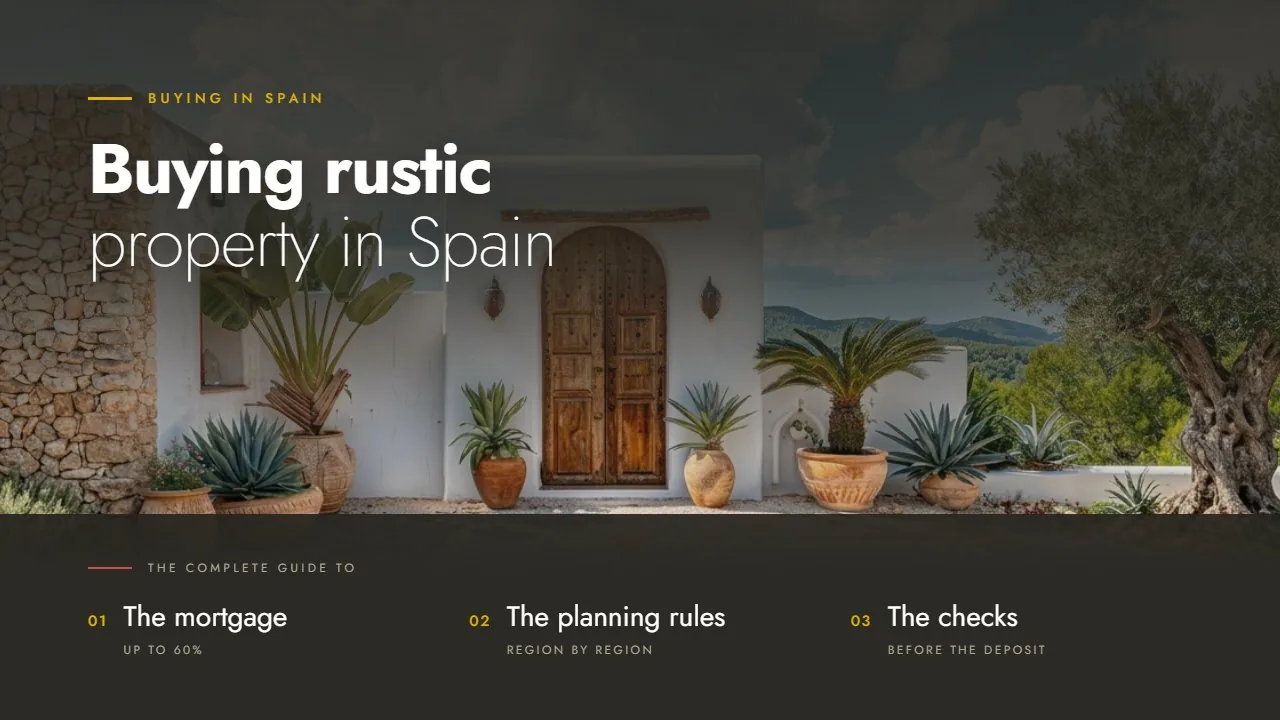

Rustic property in Spain is not only the farmhouse miles from anywhere. Many villas on the edge of a town are on rustic land too, and buyers often only find out from the nota simple or the bank’s valuation.
Whether it is a remote cortijo or a villa with mains water and a paved road, buying on rustic land is different from buying in a town or on an urbanisation:
- The paperwork often lags behind the house. Extensions, pools and annexes are frequently not registered.
- The rules depend on where it is. Each region, and each town hall, applies its own planning rules.
- The bank lends less. Usually up to 60%, and only against what is legally registered.
Most of the problems can be found before you pay a deposit, if you know where to look.
This guide covers each of these in turn, with two tools to help: a calculator for the cash you will need, and an 7 question check for a property you have found.
Read the video transcript
Buying rustic property in Spain? Many villas close to towns are on rustic land too, and it changes the purchase. Rustic land is land outside a town’s built-up and planned areas. It can start at the last street of a town. The catastro shows whether a property is classed as rústico or urbano. The town hall confirms it. The land registry, the tax record and what is actually there. On rustic property they often disagree. The bank’s valuer only counts what is registered. 260 m² on the ground, 180 m² on the registry: valued as 180. Most banks lend up to 60% on rustic property, not the 70% to 80% they lend on a town apartment. The same €450,000 rustic villa: €279,000 in cash with the extension unregistered, €237,000 once it is registered. If part of a house was built without a licence, the town hall can order it down, but in most regions only for 4 to 8 years. In Catalonia and the Valencian Community there is now no time limit on rustic land. Once the time limit has passed, the building can usually be kept, registered and sold, but not extended. Then the rustic checks: a whole plot, water, drainage, power, access and fire rules. Need holiday rental income? Check the house can be registered for it before you commit. Check it all before you sign the arras contract, or protect your deposit in it. Work out the cash you need and check a property you have found, in the full guide.
The short answer
Yes, anyone can buy rustic property in Spain, including non-residents (buyers from outside the EU need military authorisation in a few defence areas, mainly on the Balearic and Canary Islands). With the right checks first, it need not be riskier than any other purchase. What changes is what needs checking:
- Is everything legal and registered? Many rustic homes have extensions, pools or annexes that were never licensed or registered. Whether they can be kept and registered depends on the region and when they were built.
- Could anything be ordered to come down? If part of the house was built without a licence, the town hall can order it to be demolished, but in most regions only for a set number of years after it was finished. That time limit runs from 4 years to 8 depending on the region, and in some regions, and on some protected land, there is no limit at all.
- Does the house work as a home? Water, drainage, power and access are often private arrangements on rustic land, and each needs its own paperwork.
- Will the bank lend? Usually up to 60% rather than 70% to 80%, and only against what is registered. A house that is not habitable is normally a cash purchase.
Most rustic purchases that go wrong do so because one of these was not checked before the deposit was paid. All of them can be.
What counts as rustic property?
In Spanish legal language a finca is any property: a flat is a finca urbana, and a plot in the countryside is a finca rústica. In English-language adverts, the words are used more loosely:
- Finca: usually a country house with land.
- Cortijo: a traditional southern Spanish farmhouse. In Catalonia, a masía.
- Villa: can be on either urban or rustic land.
Neither the name on the advert nor how rural the house looks tells you the legal position. The land classification does.
Every piece of land in Spain is classified by the town’s planning rules, within a framework set by the region:
- Urban land (suelo urbano) is where towns and developments are built.
- Rustic land (suelo rústico, or suelo no urbanizable in some regions) is land outside the town’s built-up and planned areas. Building a new home there is heavily restricted, and often not allowed at all. It can start at the last street of a town.
Each region divides rustic land into its own categories, but they come down to two main types:
| Type of rustic land | What it is | What it means for an existing house |
|---|---|---|
| Protected rustic land | Land protected for its environment, landscape, farming value, water, coast or heritage, or because of a natural risk such as flooding. | The strictest rules. In many regions there is no time limit for acting against unlicensed building here. |
| Common rustic land | Ordinary countryside with no special protection. | Where most rustic homes are. In most regions, old unlicensed buildings can no longer be demolished once a time limit has passed. |
The classification is shown in the town’s general plan (usually called the PGOU) and confirmed by the town hall’s planning department. It is the first thing to find out about any rustic property, because most of what follows depends on it.
Many country houses have grown over the years without permission: an extra bedroom, a covered terrace turned into a room, a pool, a guest annex. Some were built without a licence in the first place. It is common, and the current owner is often not the one who did it. It still matters, because for the bank and the town hall the unlicensed, unregistered part does not count.
Rustic does not mean remote
A lot of the rustic property international buyers look at is not remote at all. Typical examples:
To check the classification, look at the cadastral record (free on the Catastro’s online office), which shows the property’s class as rústico or urbano, then confirm it with the town hall’s planning department. The two can differ, and the town’s plan is what counts for planning.
The classification matters for three reasons, whatever the house looks like. Banks usually apply their rustic lending policy based on the land, not the look of the house. The planning rules for extensions, pools and new buildings are the rustic ones. And the time limits for acting against unlicensed building are the rustic ones, which in some regions means no limit at all.
The three records that must match
On a rustic property there are three records to compare, and they often disagree:
When all three match, a rustic purchase is not much harder than any other. When they do not, each difference has to be explained. A typical case:
- The registry shows a 120 square metre house on a 4,000 square metre plot.
- The catastro shows 190 square metres and a pool.
- On the ground there are 230 square metres, a pool and a studio.
For each difference you need to know when it was built, whether it can be registered, and what that will cost and take.
How do Spanish banks value and lend on rustic property?
The bank instructs its own valuer (tasador), who follows the national rules for mortgage valuations (Orden ECO/805/2003). Three points matter on a rustic property.
Only registered, legal floor area counts
The valuer works from the nota simple, not the cadastral record. Unregistered square metres are left out, however solid they are. A house with 180 square metres on the registry and 260 on the ground is valued as a 180 square metre house.
The land is valued as rustic land
Rustic land is valued on what comparable rustic land sells for, or what it could earn, with nothing added for building potential. A large plot often adds much less to the valuation than it added to the asking price.
Missing documents stop the valuation being used
If key documents are missing, or the valuer cannot check something the rules require, the valuation is issued as conditioned (condicionada), and banks will not lend on it until the condition is lifted. Smaller issues appear only as warnings (advertencias), which do not stop the loan.
The bank then lends up to its limit on rustic property, usually 60% at most, of the lower of the purchase price and the valuation. Unregistered metres therefore cost you twice: the valuation is lower, and the percentage is lower.
Banks also expect the basics to be in place:
- Registered: the house is on the nota simple.
- Habitable: water, power, a working kitchen and bathroom.
- Recorded as a home: the catastro shows it as a dwelling, not a farm building.
If the buildings are not habitable (a ruin, a farm store, a house with no kitchen or bathroom), most banks will not lend at all, and it becomes a cash purchase. Banks that do lend on rustic property differ in what they accept, so the choice of bank matters.
Our guide to mortgages for non-residents covers what else banks look at, and our Spanish mortgage guide explains the process.
A worked example
A villa on rustic land ten minutes from town, for sale at €450,000. The nota simple shows a 180 square metre house on a 5,000 square metre plot. There is also an 80 square metre extension, built about fifteen years ago and never registered. The figures are illustrative; the real valuation comes from the bank’s valuer, and taxes and fees depend on the region.
| Rustic villa, extension not registered | Rustic villa, extension registered first | Town apartment, same price | |
|---|---|---|---|
| Purchase price | €450,000 | €450,000 | €450,000 |
| Bank valuation | €360,000 | €430,000 | €450,000 |
| Most the bank lends | 60%: €216,000 | 60%: €258,000 | 70% non-resident: €315,000 |
| Deposit you put in | €234,000 | €192,000 | €135,000 |
| Taxes and fees, about 10% | €45,000 | €45,000 | €45,000 |
| Cash you need | €279,000 | €237,000 | €180,000 |
Same property, same price: €42,000 more cash needed because the extension is not registered, and €99,000 more than for a town apartment at the same price. On a rustic purchase, check the paperwork before you agree the price. If the seller cannot register the extension before completion, that is grounds to negotiate.
Only registered buildings count. If you are unsure, try 75% to 85% of the price.
The bank lends on the lower of the price and the valuation, so a low valuation increases the cash you need.
An estimate, not an offer. Taxes and fees include transfer tax, notary, land registry, gestoría, legal fees and the bank’s valuation and arrangement fees. For a full breakdown, use our purchase costs calculator.
How long the authorities have to act, by region
When a building or extension is put up without a licence, the town hall (and in some cases the region) can order it to be demolished or put back as it was. In most regions that power has a time limit, counted from when the work was completely finished.
Once the limit has passed, the building can no longer be demolished. It does not become legal, but it can usually be kept, registered and sold.
The time limit is set by each region, and the differences are large:
| Region | Time limit on common rustic land | Main exceptions |
|---|---|---|
| Andalucia | 6 years | No limit on public land, land at risk of flooding or landslides, the coastal zone and illegal subdivisions |
| Aragon | 4 years (depends on how the breach is classed) | No limit on protected rustic land |
| Asturias | 4 years | No limit on protected rustic land |
| Balearic Islands | 8 years | No limit on protected rustic land. A one-off legalisation scheme is open on each island for a limited period |
| Canary Islands | 4 years | No limit on environmentally protected rustic land |
| Castilla-La Mancha | 8 years for new buildings | No limit where both regional and town planning specially protect the land |
| Castilla y León | 8 years | 10 years on protected rustic land; no limit on public land and public open space |
| Catalonia | No time limit | Applies to all rustic land. Buildings already time-barred under an earlier law stay protected |
| Extremadura | 6 years | No limit on protected natural areas, Natura 2000 sites and illegal subdivisions |
| Galicia | 6 years | No limit on green zones, open spaces, public facilities and public land; check the position on protected rustic land |
| Madrid | 6 years (4 years before December 2024) | 15 years on protected rustic land, which covers much of the region; no limit on roads, green zones, open space and public land |
| Valencian Community | No time limit (since 2019) | Applies to all rustic land. Buildings already time-barred under the earlier limits (4 years to 2014, then 15) stay protected |
| Cantabria, La Rioja, Murcia, Navarre, Basque Country | 4 years in most cases | Longer limits on rustic land in Cantabria (15 years) and on protected land in Navarre (10 years) |
The table shows why the region matters as much as the property. In Catalonia and the Valencian Community, a recent unlicensed building on rustic land can be acted against at any time, so a recent unregistered extension there is a much bigger risk than the same extension in Andalucia or Galicia.
Two more points apply everywhere. First, the time limit does not run while a planning case (expediente de disciplina urbanística) is open against the building. Cases are often noted on the nota simple, but not always, so ask the town hall directly. Second, “time-barred” does not mean “legal”. It only means the building can no longer be demolished.
What happens to an old unlicensed building?
Once the time limit has passed, most regions give the building a restricted status, usually called fuera de ordenación (outside the plan). The name and procedure vary:
- Andalucia: the town hall issues a formal declaration known as an AFO (asimilado a fuera de ordenación).
- Balearic Islands: a one-off extraordinary legalisation for buildings already time-barred. It runs for three years from 2024, costs 10% to 15% of the building cost, and puts a registered, permanent ban on letting the property to tourists.
The effect is similar in most regions:
What is usually allowed
What is usually not allowed
Taking Andalucia’s AFO as an example:
- Services: the building is generally expected to have its own supply (solar power, a well, a septic system), and can connect to mains only where the networks are close by and the town hall allows it.
- Application: the owner applies with a report from an architect or other qualified técnico showing when the building was finished and that it is safe and habitable.
- Decision: the town hall has six months to decide, and no reply in that time counts as a refusal.
- Cost and speed: each town hall sets its own fee and works at its own pace.
Getting old buildings onto the registry
A full declaration such as an AFO is not always needed. Our mortgage team sees this regularly: it depends on the town hall, and many will issue a certificate that no planning case is open against the building, or that the time limit has passed. That is often enough for the notary to declare the extra metres.
The national route is a declaración de obra nueva por antigüedad: a deed signed at the notary declaring that a building exists and is older than the regional time limit.
The owner proves its age with one of these:
- a certificate from an architect or técnico;
- a certificate from the town hall;
- a notarial record;
- the cadastral certificate showing when the building first appeared.
The registrar then checks that the land is not public land or subject to public easements, that no planning case is noted, that the regional time limit has passed, and that the building is mapped. If all is in order, the registrar registers it and notifies the town hall.
Where the region now has no time limit on rustic land, as in Catalonia and the Valencian Community, registrars refuse this route for recent buildings. A building finished while an earlier limit applied, and older than that limit, can still be registered this way.
In Andalucia, registry rulings have allowed old buildings to be registered this way without an AFO, although some registrars, and many banks, still ask for one. The deed is taxed: declaring the building costs notary and registry fees, plus stamp duty (AJD) on the value of the building at the region’s rate. Once the metres are on the nota simple, the bank’s valuer can count them.
Land with no time limit
Apart from the regions with no limit at all, every region has some land where the authorities can act against unlicensed building at any time, however old it is. The details vary, but the list usually includes:
If the property is on any of this land and has unlicensed building, take legal advice before you pay anything.
Issues that come with rustic land
A rustic property with perfect planning paperwork still has issues that a house on urban land does not, even close to a town. Each is easy to check before you commit and harder to fix afterwards.
Buying the whole plot, and the neighbours
Check that you are buying the whole plot. Rustic land cannot normally be split without a licence, and each region sets a minimum plot size for farmland, often well above a typical house and garden.
Some sellers get round this by selling a share of a larger plot (a proindiviso share) with a private agreement on who uses which part. Registries now block many of these sales, and a share without a licence can leave you with a house you cannot register, mortgage or easily sell.
Two rights to buy can also apply to rustic land:
- Neighbours: under the Civil Code, a neighbour who owns adjoining rustic land can take over the sale of a rustic plot of one hectare or less, at the same price, within nine days of the sale being registered. The courts look at how the land is used, so it rarely applies to a house and garden, but your lawyer should check it on a small plot.
- The region: in protected natural areas, some regions have a right to buy first, and the sale cannot be registered until the region has been notified.
Water
Ask exactly where the water comes from, even close to a town.
- Mains: the simplest, but check it is a proper contract and not an informal connection.
- A well: one on your own land drawing up to 7,000 cubic metres a year (far more than a household uses) does not need a full water concession, but it must be authorised by the water authority and entered on the water register. An unregistered well can be ordered closed.
- Aquifers at risk: where the aquifer is declared overexploited or at risk, even a small well needs prior permission and may be refused.
- Irrigation: if the garden or olive trees rely on irrigation water, check that any rights go with the property.
The water authority is the river basin body (confederación hidrográfica) or, in some regions, a regional water agency. The Canary Islands have their own water law.
Drainage
Many rustic properties, including some close to towns, are not on mains drains. A septic tank or small treatment plant that discharges into the ground needs a discharge authorisation from the water authority. A sealed tank emptied by a licensed contractor is treated differently. Ask which it is, whether it is authorised, and when it was last emptied.
Electricity
Regional planning laws often stop power and water companies connecting buildings without a licence. In Andalucia, for example, a building with neither a licence nor an AFO cannot be connected. Many rustic homes run on solar panels and batteries, which can work well. If so, have the system checked: batteries are expensive to replace, and a system that copes in summer may not cope in winter.
Access
Check how the house is reached: a public road, a track, or a path across a neighbour’s land. If it crosses someone else’s land, the right of way (servidumbre de paso) should be registered. An informal arrangement with the current neighbour may not survive a new neighbour. Public tracks and livestock routes cannot be fenced or closed.
Fire
Much of rural Spain is forest or scrub, and most regions have fire prevention rules for homes near it. In Andalucia, for example, a home on or within 400 metres of forest land in a fire danger area needs:
- a fire self-protection plan (plan de autoprotección) filed with the town hall;
- a cleared strip at least 15 metres wide around the buildings.
Town halls fine owners who do not clear their land. Ask the seller what applies and whether it has been done.
Tax
- Transfer tax (ITP): from 4% to 13% on a resale, depending on the region and, in some regions, the price. A rustic property with a house normally pays the region’s rate for homes; land bought for farming can qualify for reliefs.
- Property tax (IBI): once a building is added to the catastro, the town hall can charge the higher IBI for up to four past years. If the catastro does not match what is there, that bill goes to whoever owns the property when the catastro catches up.
Letting a rustic property to holidaymakers
Rental income is often part of the plan for a rustic property, and it is where plans most often fail. Tourist rental rules are set by each region, many town halls now limit numbers, and rustic land and houses with a restricted planning status often face extra conditions. For example:
- Andalucia: a tourist rental no longer has to be on residential land, but the use must be allowed by the town’s plan. A house with an AFO cannot be registered for tourist rental without the town hall’s express approval.
- Balearic Islands: homes legalised under the extraordinary scheme cannot be let to tourists.
If you need the rental income, including to pay the mortgage, check that the house can be registered before you commit. A seller’s rental history is not proof: a house let for years without registration may not be able to get one.
The checks to make before you pay a deposit
On a rustic property, make these checks before the arras contract (the binding deposit agreement), because pulling out afterwards usually costs you the deposit. Our guide to the arras contract explains why.
Compare the nota simple and the cadastral record with what is there
Land area, house size, pool, annexes and outbuildings. Each difference is a question for the seller and the town hall.
Check the land’s classification and planning history at the town hall
The type of rustic land, any open planning case, and whether the property is on or next to a river, the coast, a livestock route or protected land.
Find out what paperwork the unregistered parts can get
Whether the region’s time limit has passed, what the town hall will issue and how long it takes. Then agree who does it and who pays, ideally the seller, before completion.
Check you are buying the whole plot, with a clean title
No shares, no private split of a larger plot, no unexpected charges. On a small plot, consider the neighbours’ right to buy; in a protected natural area, the region’s.
Check the water, drainage and power
Where the water comes from and whether the well is registered, what the drainage is and whether it is authorised, and whether the electricity is a proper contract or a solar system worth having inspected.
Check access, boundaries and fire rules
A public road or registered right of way, a fence line that matches the plot, and any fire prevention obligations.
Check the rental position, if you need the income
Whether the house can be registered for holiday lets, and under which rules.
Get a mortgage view before you agree the price
Which banks will lend on this property, and roughly what the valuation will be. On rustic property this can change the price you should offer.
If you go ahead before everything is resolved, protect yourself in the arras contract. It can make the deposit refundable if the mortgage is refused, if the valuation comes in below an agreed figure, or if the seller does not deliver a promised registration or certificate by an agreed date. It can also hold back part of the price at the notary until the paperwork is done.
What fixing the paperwork costs, and how long it takes
Costs vary with the town hall and the property, so treat these as a guide, not a quote. The total is usually a few thousand euros and can exceed ten thousand on a large or complicated property. Who pays is negotiable, and it is usually reasonable to ask the seller, who is selling metres that are not on the registry.
| Step | What it involves | Typical time |
|---|---|---|
| Técnico’s report | An architect or técnico measures and dates the buildings and certifies they are safe and habitable. The fee depends on the size of the property. | A few weeks |
| Town hall certificate or declaration | The town hall confirms there is no planning case, or issues a formal declaration such as an AFO. Each town hall sets its own fee. | A few weeks for a certificate; six months or more for a declaration |
| Deed declaring the building | The obra nueva deed at the notary, with notary fees and stamp duty on the value of the building. | Days, once the documents are ready |
| Land registry | The registry records the building and notifies the town hall. Registry fees apply. | Usually a few weeks |
| Catastro and IBI | The cadastral record is updated and the property tax follows. | Weeks to months |
The purchase itself usually takes longer than for a town apartment, mainly because of the checks and the bank’s valuation. In our experience:
- Clean paperwork: often eight to twelve weeks from an accepted offer to completion.
- A town hall declaration needed before the bank will lend: several months longer.
Bear this in mind before you agree a completion date. Our guide to how long a Spanish mortgage takes covers the mortgage side.
When should you walk away?
Most issues on a rustic property can be solved with time and the right paperwork. These usually cannot:
Questions to ask the seller and the agent
Ask these early, and in writing.
- Can you send the nota simple, the cadastral record and the last IBI receipt?
- Is everything on the land shown on the nota simple? If not, what was built, and when?
- Does the property have a town hall certificate or declaration for any unregistered parts? Can we see it?
- Has the town hall ever opened a planning case or written about the property?
- Where does the water come from? Is the well registered? Are there irrigation shares?
- What is the drainage, and is it authorised? How is the electricity supplied?
- How is the house reached? Is any right of way registered?
- Are you selling the whole plot? Do the boundaries match the fence?
- Are there fire prevention obligations? Is the property in a protected natural area?
- Has the house been let to holidaymakers, and is it registered for it?
How Foxes handles a rustic purchase
Rustic property can be a minefield, which is why the mortgage and the legal work are best done by one team. Before you sign anything:
- Our lawyers compare the nota simple with the cadastral record and with what is there, ask the town hall where the property stands, and check the title, water, access and the rest.
- Our mortgage team tells you which banks will lend on the property and what valuation to expect, so you know the cash you need before you agree a price.
Where unregistered parts can be brought onto the registry, we tell you how, how long it is likely to take, and whether the seller should do it before completion. If you go ahead, we write the checks into the contract so your deposit is protected if the mortgage or the paperwork does not come through.
Our conveyancing service explains how we work. If you are buying from abroad, a power of attorney lets us complete without you travelling, and our guide to who does what in a Spanish purchase explains the roles of the lawyer, gestor and notary.
Found a rustic property? We check it before you commit
Our Spanish lawyers and our Bank of Spain registered mortgage team (D470) look at the paperwork, the town hall position and the mortgage together, so you know what you are buying and what it will cost before you pay a deposit.
Frequently asked questions
How do I know if a property in Spain is on rustic land?
Check the cadastral record, which shows the property’s class as rústico or urbano, then confirm the classification with the town hall’s planning department, because the town’s plan is what counts. Many villas close to towns are on rustic land, so do not judge by how rural the house looks.
Is a villa near a town on rustic land treated differently by the bank?
Usually yes. Banks generally apply their rustic lending policy based on the land classification, not how close the house is to a town, so expect a lower maximum loan, often up to 60%, and a valuation that only counts registered buildings.
Can I get a mortgage on a rustic property in Spain?
Yes. Many Spanish banks lend on rustic property, usually up to 60% of the lower of the purchase price and the bank’s valuation, though some do not lend on it at all. The valuation only counts what is registered on the nota simple, so unregistered parts of the house do not add to the mortgage.
How much can I borrow on a rustic property in Spain?
Usually up to 60% of the value, compared with around 70% for non-residents and 80% for residents on a town property. On rustic property the valuation is often below the price, because the valuer only counts registered buildings and values the land as rustic land.
Do banks value a property from the nota simple or the catastro?
From the nota simple, the land registry record. Square metres that appear in the cadastral record or on the ground but are not registered are not included in the bank’s valuation.
How long do the authorities have to act against an unlicensed building in Spain?
It depends on the region. On common rustic land the limit is 4 years in the Canary Islands and Asturias and usually in Aragon, 6 years in Andalucia, Galicia, Extremadura and Madrid, and 8 years in the Balearic Islands, Castilla-La Mancha and Castilla y León. In Catalonia and the Valencian Community there is no time limit on rustic land, although buildings already time-barred under earlier laws stay protected.
What happens to an unlicensed building once the time limit has passed?
It can no longer be demolished, but it does not become legal. It usually has a restricted status, often called fuera de ordenación: it can be kept, maintained, registered and sold, but not extended. In Andalucia the town hall issues a formal declaration called an AFO.
What is an AFO in Spain?
AFO (asimilado a fuera de ordenación) is a declaration by an Andalucian town hall that a finished building put up without a licence can no longer be demolished because the time limit has passed. It allows the building to be registered, sold and mortgaged, but not extended. The town hall has six months to decide, and no reply counts as a refusal.
Do I need a town hall declaration to register an old building?
Not always. An old building can be declared at the notary with proof of its age, such as an architect’s certificate or the cadastral record, provided the region’s time limit has passed. Many town halls will also issue a certificate that no planning case is open, which is often enough. Some registrars and banks still ask for a formal declaration.
Is it safe to buy a property with an extension that is not registered?
It can be, if the extension is older than the region’s time limit, the land is not in a category with no time limit, and there is no open planning case. The risk is in the price and the mortgage: the bank will not value the unregistered part until it is registered.
Can I get a mortgage on a rustic property that is not habitable?
Usually not. Banks expect a registered, habitable home with water, power, a kitchen and a bathroom. A ruin, a farm store or bare land is normally a cash purchase.
Can I buy part of a rustic plot in Spain?
Usually only with a licence. Buying a share of a larger plot with a private agreement on who uses which part is risky, because registries often block these sales without a licence.
Can I rent out a rustic property as a holiday let in Spain?
Sometimes. Tourist rental rules are set by each region and many town halls limit numbers. Rustic land and houses with a restricted planning status often face extra conditions: in Andalucia a house with an AFO needs the town hall’s express approval. Check before you buy if you need the income.
What should I check before buying a rustic property in Spain?
Compare the nota simple with the catastro and with what is there, check the land’s classification and any planning case at the town hall, find out whether the region’s time limit has passed for any unregistered parts, and check the title, water, drainage, electricity, access, boundaries, fire rules and rental position. Do it before you pay the arras deposit.
- National: Real Decreto Legislativo 7/2015 (land law), art. 28.4, declaring old buildings at the registry; Orden ECO/805/2003, mortgage valuations; Código Civil, arts. 1523 and 1524, and Ley 19/1995, minimum farm sizes; Texto Refundido de la Ley de Aguas, art. 54.2, wells.
- Regional time limits: Andalucia, Ley 7/2021 (LISTA), art. 153; Aragon, Decreto Legislativo 1/2014; Asturias, Decreto Legislativo 1/2004, art. 241; Balearic Islands, Ley 12/2017, art. 196; Canary Islands, Ley 4/2017, art. 361; Castilla-La Mancha, Decreto Legislativo 1/2023, art. 182; Castilla y León, Ley 5/1999; Catalonia, Decreto Legislativo 1/2010, art. 207; Extremadura, Ley 11/2018, art. 179; Galicia, Ley 2/2016, art. 153; Madrid, Ley 9/2001, art. 195; Valencian Community, Decreto Legislativo 1/2021, art. 255.
- Andalucia examples: LISTA arts. 173 and 174 (AFO); Ley 2/1989 (protected natural areas); Ley 5/1999 and Decreto 247/2001 (fire); Decreto 28/2016 as amended by Decreto 31/2024 (tourist rentals).
This guide is general information, not legal advice on a particular property. Rules and how town halls apply them vary. Last reviewed September 2026.