
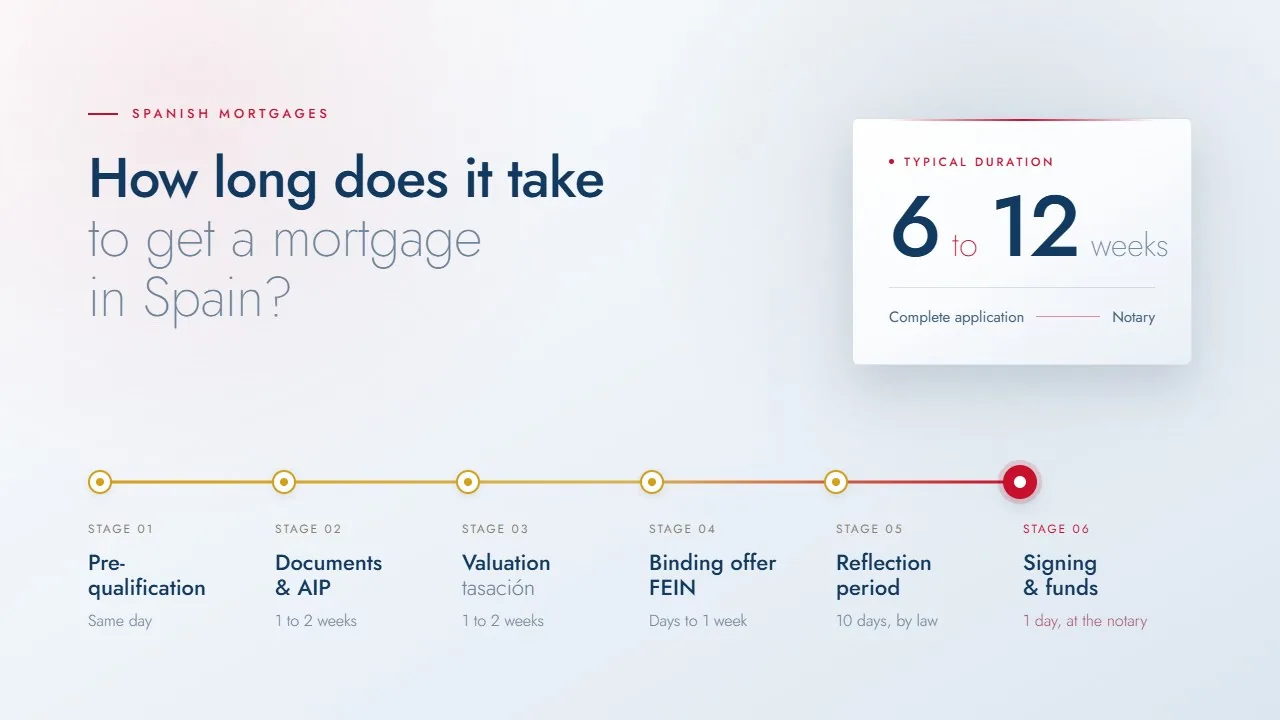

Six to twelve weeks from a complete application to signing at the notary is normal for a Spanish mortgage. Some files complete in five; anything past fourteen usually means a document is missing or a valuation is waiting. The stages themselves are short; the time goes on the handovers between them and on the purchase running alongside. This guide sets out the six stages, how long each one takes, what slows a non-resident down, and how to line the mortgage up with the purchase so you are never asked to complete before the money is ready.
What are the stages of a Spanish mortgage application?
Every Spanish mortgage runs through the same sequence, whether the bank is BBVA or a small regional cooperative. The order is fixed by law at the end (binding offer, reflection period, notary) and by practice at the start. Where the weeks go depends on you as much as the bank: the longest single stretch in most files is the time it takes the buyer to gather documents. The rules behind each stage, the documents and the costs are in our complete guide to getting a mortgage in Spain.
| Stage | Who does the work | Typical time |
|---|---|---|
| 1. Pre-qualification | You and your broker | Same day |
| 2. Documents and agreement in principle | You gather, the bank reads | 1 to 2 weeks |
| 3. Valuation (tasación) | An approved valuer, booked once you have a property | 1 to 2 weeks |
| 4. Final approval and binding offer (FEIN) | The bank’s risk department | A few days to 1 week |
| 5. Reflection period and notary check | You, your lawyer and the notary | 10 calendar days, fixed by law |
| 6. Signing and funds | Everyone, at the notary | 1 day, usually the same day as the purchase deed |
The six stages on one line
What happens at each stage?
Pre-qualification: same day
A read of your income, deposit, age and existing debts against Spanish lending rules: up to seventy percent of the price for a non-resident, eighty percent for a resident, total monthly debt under forty percent of net income, and the loan repaid by age seventy-five. You know what you can borrow before you view anything. Ours takes a few minutes online and does not touch your credit file. Start here: check if you qualify.
Documents and agreement in principle: one to two weeks
With a complete file, an international desk gives an agreement in principle on amount and rate within a few days to a week. Most of the fortnight is the buyer assembling the paperwork, not the bank reading it. Send everything below in one go; a file that arrives in instalments goes to the back of the queue each time. More detail on each document is in our lending guide.
Valuation: one to two weeks
Once you have an accepted offer, the bank instructs a valuation company registered with the Bank of Spain. You pay for it, typically three hundred to six hundred euros depending on the property, and it is valid for six months. The bank lends against the lower of the price and the valuation, so a low valuation means a bigger deposit, not a smaller purchase. Access to the property is the usual delay: a tenant, a seller abroad, or an agent on holiday can add a week.
Final approval and the FEIN: a few days to a week
With the valuation in, the bank’s risk department gives final approval and issues the FEIN, the European Standardised Information Sheet, with the FiAE warnings sheet alongside it. The FEIN is a binding offer: it sets out the rate, the fees, the repayment schedule and every condition, and the bank cannot change those terms while it is valid. Read it with your lawyer, not just your broker. What the rate on it should look like.
Reflection period and notary check: ten days
Spanish law requires at least ten calendar days between the day you receive the FEIN and the day you sign. In Catalonia the regional consumer code makes it fourteen. During that period you visit the notary (or your lawyer does under power of attorney) for a free session in which the notary confirms you have received the documents, understand the terms and have had them explained. The notary records this in an acta no later than the day before signing. Without it, the deed cannot be signed.
Signing and funds: one day
The mortgage deed and the purchase deed are normally signed at the same notary appointment. The bank’s representative attends, the loan is drawn, the seller is paid, and the keys change hands. Since 2019 the bank pays the notary, the registry, the gestoría and the stamp duty on the mortgage deed; you pay the valuation and your own copy of the deed. If you cannot travel, a power of attorney granted to your lawyer lets all of this happen without you.
What slows a Spanish mortgage down?
The bank is rarely the bottleneck. These are the things that add weeks in the files we see, roughly in order of how often they happen.
| Delay | Why it happens | What to do |
|---|---|---|
| Incomplete documents | A missing payslip or an unsigned tax return sends the file back to the queue | Send everything in one go, checked against the list, not in instalments |
| No NIE | You cannot sign a mortgage deed without one, and appointments can take weeks in busy provinces | Apply the week you decide to buy. How to get your NIE |
| Non-euro income | Banks apply a haircut to foreign-currency income and want extra evidence of it | Provide two years of history, not one, and expect the affordability test to be stricter |
| Self-employed or company income | Two years of accounts and tax returns are read line by line | Have your accountant produce a one-page income summary alongside the accounts |
| Valuation access | The valuer cannot get in | Agree a valuation date with the agent when you sign the reserva |
| Translations | A few banks want sworn translations of non-Spanish documents | Ask at the start; most international desks accept English |
| August | Risk departments, notaries and valuers all thin out | Add two weeks to any timeline that crosses it |
How do you fit the mortgage into the purchase timeline?
The Spanish purchase has its own clock. You reserve the property with a small holding deposit, then sign a private contract, the contrato de arras, and pay a deposit of around ten percent, with a completion date typically six to twelve weeks later. If you are not ready to complete on that date and the contract has no protection, the seller can keep the deposit. That is where a slow mortgage costs you money in a Spanish purchase.
Two things prevent it. First, pre-qualify and get the agreement in principle before you make an offer, so that the only stages left after the arras are the valuation, the FEIN and the ten days. Second, have your lawyer write a financing condition into the arras: if the mortgage is refused, or not issued by the completion date, the deposit is returned. Sellers accept it far more often when the buyer can show an agreement in principle. The full purchase process, step by step.
Is it faster with a broker or direct with a bank?
Neither route shortens the ten days, the valuation or the notary. Where a broker saves time is everywhere else: the file goes in complete the first time, several banks are approached at once rather than one after another, and the valuation, the bank account and the notary appointment are lined up with your lawyer instead of discovered in sequence. Where going direct costs time is the same list, in reverse.
Direct with one bank
Through a registered broker
A broker in Spain must be registered with the Bank of Spain as a credit intermediary; ours is D470, and you can check any broker on the Bank’s public register before you send them a document.
What about a new build or off-plan purchase?
The clock runs differently. On a new build the bank lends against the finished property, so the mortgage is applied for in the months before completion, not at reservation, and the valuation is of the built home. On an off-plan purchase the developer takes staged payments from your own funds during construction, and no bank will release a mortgage until the property has its licence of first occupation. The practical rule: get the agreement in principle when you reserve, so you know the finance exists, then run stages three to six in the final two months before the developer’s completion date. Watch the age limit too: if construction runs two years, the bank counts your age at completion, not at reservation.
What does a real timeline look like?
An illustrative file, a UK couple buying a resale apartment as non-residents, with the documents ready in advance. Dates are examples, the gaps between them are typical.
| Date | What happened | Elapsed |
|---|---|---|
| Monday 2 March | Pre-qualified online, documents sent the same week | Week 1 |
| Friday 13 March | Agreement in principle from two banks | Week 2 |
| Friday 20 March | Offer accepted, reserva paid, valuation booked | Week 3 |
| Tuesday 31 March | Arras signed with a financing condition, completion set for 29 May | Week 5 |
| Thursday 2 April | Valuer visits; report to the bank on the 10th | Week 5 |
| Friday 17 April | Final approval; FEIN and FiAE issued, the ten days start | Week 7 |
| Tuesday 28 April | Lawyer attends the notary under power of attorney for the acta | Week 9 |
| Tuesday 5 May | Mortgage and purchase deeds signed, funds released, keys | Week 10 |
Is it slower for non-residents?
Slightly, and for predictable reasons: more documents, documents in another language, income in another currency, and the NIE. None of it changes the sequence, and none of it need add more than a week or two if the file arrives complete. Non-residents lose time by starting the mortgage after the offer and finding the NIE appointment is three weeks away. How non-resident mortgages work, and what changes if you are buying from the UK, the United States or Ireland.
What does not slow you down: being a non-resident does not mean a different approval process, a different notary procedure or a longer reflection period. The ten days are the same for everyone.
Want the number before you start the clock?
The calculator gives you the borrowing, the monthly payment and the cash you need to complete, on real Spanish bank criteria. Pre-qualification takes a few minutes more.
Common questions
How long does a Spanish mortgage take from application to completion?
Six to twelve weeks from a complete application to signing at the notary is normal. The fixed part is the ten-day reflection period after the binding offer; the variable parts are how quickly you supply documents and how soon the valuer can access the property.
Can I get a Spanish mortgage approved before I find a property?
You can get an agreement in principle on the amount and rate, based on your documents, before you have a property. Final approval and the binding offer need the valuation, so they wait for an accepted offer. Doing the first part early saves more time than anything else.
What is the FEIN and how long is it valid?
The FEIN is the binding offer a Spanish bank must give you before you sign, setting out the rate, fees and conditions in a standard European format. It states its own validity period, and the bank cannot change the terms during it. You must receive it at least ten calendar days before signing, fourteen in Catalonia.
Do I have to be in Spain to sign the mortgage?
No. A power of attorney granted to your lawyer lets them attend the notary for the acta and for signing. Many non-resident buyers complete without a second trip. The power of attorney can be signed at a Spanish notary while you are here, or abroad with an apostille and sworn translation.
How long is a Spanish property valuation valid for?
Six months. If the purchase drags past that, the bank will ask for an updated valuation, which you pay for again, so a valuation is best commissioned once the purchase is firm rather than at the first viewing.
What if the mortgage is not ready by the completion date in the arras?
If the arras contains a financing condition, the deposit is returned or the date extended. If it does not, the seller can keep the deposit and walk away. Have your lawyer write the condition in, and get the agreement in principle before signing the arras so the remaining stages are short and predictable.
Who pays the mortgage costs in Spain?
Since the 2019 mortgage law the bank pays the notary, the land registry, the gestoría and the stamp duty on the mortgage deed. The borrower pays the valuation, typically three hundred to six hundred euros, and their own copy of the deed. Purchase taxes and fees on the property itself are separate and are yours.
Foxes is a mortgage and legal company registered with the Bank of Spain as a credit intermediary (D470), working with international buyers across Spain since 2015. Timescales are what we see in practice in 2026; the legal periods are fixed by Law 5/2019 and the Catalan Code of Consumption. Your bank sets the final terms.