
How you get a prescription in Spain, what you show at the pharmacy and what you pay all depend on why you are here and where you are from. This guide sets out the five situations, then the things that work the same for everyone: how the farmacia works, how electronic prescriptions run on your health card, why the box has a different name on it, and what to do about the medication you already take.
Where you are from matters
Pick your country. The table shows who can prescribe for you, what you show at the pharmacy and what you pay, for each way of being in Spain.
| You are | Who prescribes | At the pharmacy | You pay |
|---|---|---|---|
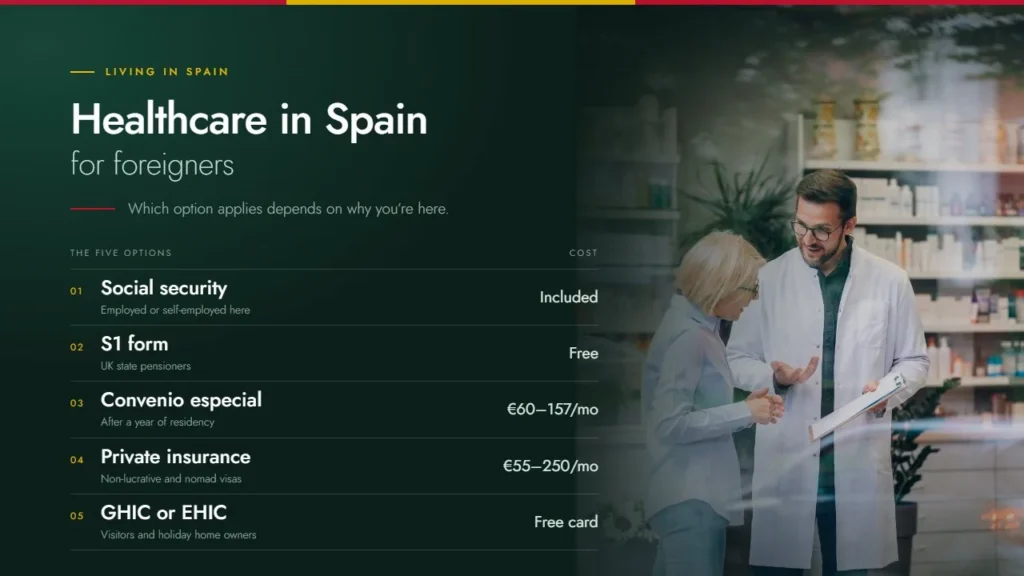
| Visiting or holiday home | A public doctor, using your GHIC and passport, for anything medically necessary during the visit. Or any private doctor. | The paper or electronic prescription the doctor gives you; visitors are not on the health card system. | The same share as a Spanish resident, in practice usually the working-age rate. Private prescriptions full price. Keep receipts for your travel insurer. |
| Working here | Your public GP, once you have a social security number and health card. | Your tarjeta sanitaria. Nothing on paper. | 40 to 60% of the price by income, with monthly caps under 35,000 euros of income. |
| UK state pensioner | Your public GP, after you register the S1 form (from NHS Overseas Healthcare Services) with the INSS and get your health card. | Your tarjeta sanitaria. | 10%, capped at 8.23 to 18.52 euros a month depending on income. |
| Living here, not working, year one | A private doctor under your private policy (a visa condition for most people). No public GP yet. | A private prescription, paper or electronic. | Full price. Most Spanish policies do not cover medication; a few reimburse a share. Budget for it if you take anything regularly. |
| On the convenio especial | Your public GP, once you have paid in after a year of residency. | Your tarjeta sanitaria. | Full price. The convenio gives you the doctor but does not subsidise the medicine. |
| You are | Who prescribes | At the pharmacy | You pay |
|---|---|---|---|
| Visiting or holiday home | A public doctor with your EHIC and ID for anything necessary during the stay, or a private doctor. A prescription from your own doctor at home also works, see below. | The prescription the doctor gives you, or your home prescription if it carries the details Spanish pharmacies need. | The Spanish resident share for a public prescription, in practice usually the working-age rate. Full price for private or home prescriptions; claim it back at home if your system allows. |
| Working here | Your public GP, once you have a social security number and health card. | Your tarjeta sanitaria. | 40 to 60% by income, with monthly caps under 35,000 euros of income. |
| State pensioner | Your public GP, after you register the S1 with the INSS. The S1 comes from your home institution: the HSE in Ireland, the CAK in the Netherlands, your Krankenkasse in Germany, the CPAM (via CNAREFE) in France, Försäkringskassan in Sweden. | Your tarjeta sanitaria. | 10%, capped at 8.23 to 18.52 euros a month by income. |
| Living here, not working, year one | A private doctor under private cover, or your home doctor if you still hold cover at home and travel back. | A private prescription, or a valid home prescription. | Full price. Most Spanish policies do not cover medication. |
| On the convenio especial | Your public GP after a year of residency. | Your tarjeta sanitaria. | Full price. The convenio does not subsidise medicine. |
| You are | Who prescribes | At the pharmacy | You pay |
|---|---|---|---|
| Visiting or holiday home | A private doctor, or a public emergency department if it is urgent. Medicare and most provincial plans do not cover you in Spain. | The private prescription. | Full price. Most generics cost a few euros a box. Travel insurance may reimburse. |
| Working here | Your public GP, once you have a work permit, social security number and health card. | Your tarjeta sanitaria. | 40 to 60% by income, with monthly caps under 35,000 euros of income. |
| Retired here | There is no S1 equivalent, so a private doctor under the private policy your visa requires, then the public GP once you join the convenio especial after a year. | A private prescription, later your tarjeta sanitaria. | Full price either way: private policies rarely cover medicine and the convenio does not. |
| Living here, not working, year one | A private doctor under private cover. | A private prescription. | Full price. |
| You are | Who prescribes | At the pharmacy | You pay |
|---|---|---|---|
| Visiting or holiday home | A private doctor. Many Gulf policies include worldwide or European cover for emergencies; check the limits before travelling. | The private prescription. | Full price, then claim from your insurer if covered. |
| Working here | Your public GP, once you have a permit, social security number and health card. | Your tarjeta sanitaria. | 40 to 60% by income, with monthly caps under 35,000 euros of income. |
| Living here, not working, year one | A private doctor under the Spanish private policy your visa requires. A Gulf policy does not satisfy the visa condition even if it covers Spain. | A private prescription. | Full price. |
| On the convenio especial | Your public GP after a year of residency. | Your tarjeta sanitaria. | Full price; the convenio does not subsidise medicine. |
| You are | Who prescribes | At the pharmacy | You pay |
|---|---|---|---|
| Visiting or holiday home | A private doctor, or a public emergency department if urgent. | The private prescription. | Full price; travel insurance may reimburse. |
| Working here | Your public GP, once you have a permit, social security number and health card. | Your tarjeta sanitaria. | 40 to 60% by income, with monthly caps under 35,000 euros of income. |
| Living here, not working, year one | A private doctor under Spanish private cover. | A private prescription. | Full price. |
| On the convenio especial | Your public GP after a year of residency. | Your tarjeta sanitaria. | Full price; the convenio does not subsidise medicine. |
How the farmacia works
Pharmacies in Spain are privately owned but tightly licensed: the law allows roughly one for every 2,800 residents and sets a minimum distance between them, so there is one within walking distance of almost every home and they all stock much the same range. Prescription medicine prices are set nationally, so every pharmacy charges the same for the same box. They are also, by law, owned and run by pharmacists rather than chains, and a pharmacist must be present whenever the shop is open.
The pharmacist is a regulated health professional with a five-year pharmacy degree, and giving advice is part of the job. Indicación farmacéutica, the pharmacist assessing a minor complaint and recommending a treatment or telling you to see a doctor, is a recognised service of Spanish pharmacies. For a cold, a rash, a stomach upset, a blood pressure check, a question about a medicine you already take or whether two medicines can be taken together, go to the pharmacy first.
What you can buy without a prescription is narrower than in some countries and wider than in others.
| Over the counter | Prescription only |
|---|---|
| Paracetamol 500 mg, and 1 g in packs of 10 or fewer | Paracetamol 1 g in full boxes |
| Ibuprofen 400 mg | Ibuprofen 600 mg |
| Antihistamines, most cold and cough remedies, antacids | Anything with codeine |
| The emergency contraceptive pill | Antibiotics, always, and it is enforced |
Opening hours
Public prescriptions run on your health card
There is no paper in the public system. Your GP or specialist prescribes electronically against your tarjeta sanitaria, the health card you get once you are registered with a centro de salud (the healthcare guide covers how to register for each situation). At the pharmacy you hand over the card, physical or in the app, and the pharmacist sees what is prescribed and dispenses it. The regional systems have been connected nationally since 2019, so a prescription written in Málaga is collected in Madrid or Bilbao without anyone phoning the doctor.
For anything you take regularly the doctor sets up a tratamiento de larga duración. You collect it a month at a time from any pharmacy, without going back to the doctor, until the year is up and the GP renews it, often without an appointment. The doctor gives you a printed treatment sheet, the hoja de medicación, listing every medicine on your card and when each can next be collected, and the pharmacy can reprint it, and the same list is in your region’s health app: ClicSalud+ in Andalucía, GVA+Salut in Valencia, La Meva Salut in Cataluña, Tarjeta Sanitaria Virtual in Madrid.
Why the box has a different name on it
Spanish doctors prescribe by active ingredient, not brand, and the pharmacist dispenses the cheapest equivalent in stock. So the box says ibuprofeno, omeprazol or atorvastatina and a manufacturer’s name rather than the brand you know, and the manufacturer can change from one month to the next. It is the same medicine at the same dose. Under current rules the pharmacist must dispense the lowest-priced version and you cannot pay extra to have a particular brand on a public prescription; a medicines bill now going through Parliament would allow paying the difference, but it is not in force.
What you pay at the till
Your share of a public prescription is a percentage of the price, taken at the counter, and the percentage depends on your income as declared on your last tax return. The bands changed on 14 May 2026.
| Your income | Workers pay | Monthly cap |
|---|---|---|
| Under €9,000 | 40% | €8.23 |
| €9,000 to €18,000 | 40% | €18.52 |
| €18,000 to €35,000 | 45% | €61.75 |
| €35,000 to €60,000 | 45% | No cap |
| €60,000 to €100,000 | 50% | No cap |
| Over €100,000 | 60% | No cap |
Private prescriptions and the convenio especial
A private doctor writes a paper prescription or a private electronic one, and any pharmacy dispenses it. You pay the full price, and most Spanish private health policies do not cover medication at all; a few reimburse a share up to an annual limit, so read the schedule before you assume. The convenio especial has the same gap: you see the public GP and your prescriptions are on your health card, but the medicine is not subsidised and you pay full price.
If you run out, or need a prescription before you are registered
If you are not yet in the public system and need a prescription, a private GP appointment costs around 40 to 80 euros and the prescription can be used at any pharmacy the same day. If you have run out of a regular medicine at the weekend, the urgencias desk at your centro de salud or a hospital emergency department can prescribe, and the farmacia de guardia dispenses. What a pharmacist cannot do is hand over a prescription-only medicine without a prescription, even to continue a treatment you can show them; the law does not allow it.
For children, medicines are prescribed on the parent’s card at the parent’s rate, most common medicines come in paediatric syrups and sachets.
Arriving with medication
Bring two to three months’ supply
In the original packaging, plus a letter from your doctor at home listing each medicine by generic name, strength and dose. Controlled medicines need that letter to get through customs, and EU residents need the Schengen certificate for them.
Check the equivalent exists
Most medicines are sold in Spain under a different brand, but not all exist here and some strengths differ. Take the letter to a pharmacist in the first week; they will tell you the Spanish name and whether it is prescription only.
Get re-prescribed here
Only an EU or EEA prescription can be dispensed in Spain. Everyone else needs a Spanish doctor to prescribe: your public GP once you have a health card, or a private GP appointment at around 40 to 80 euros if you do not yet.
Set it up as long-term
Ask for a tratamiento de larga duración so it runs for a year on your card and you collect it monthly at any pharmacy, rather than seeing the doctor each time.
The words you will hear
| Spanish | Meaning |
|---|---|
| Receta | Prescription. Receta electrónica is the public one on your card; receta privada is a private one. |
| Tarjeta sanitaria | Your public health card, which carries your prescriptions. |
| Farmacia de guardia | The pharmacy on duty outside normal hours. |
| Principio activo | The active ingredient, which is what doctors prescribe and pharmacists search by. |
| Genérico | Generic, the version you will usually be given. |
| Sin receta / con receta | Over the counter / prescription only. |
| Hoja de medicación | The printed list of what is prescribed to you and when to collect it. |
| Aportación | Your share of the price at the till. |
Buying a home here, and prescriptions
Owning a property in Spain does not put you in the health system, and nothing about a purchase or a mortgage requires a health card. It matters for the budget. If you are moving rather than holidaying and you take regular medication, the year on private cover before the convenio especial is a year of full-price prescriptions on top of the premium, and that belongs in the monthly figures alongside the mortgage.
Working out what the move actually costs?
Start with the mortgage. Put your own numbers in and see the borrowing, the monthly payment and the cash you need to complete.
Common questions
Can I use a prescription from my own country in Spain?
Only if it was written in another EU or EEA country and carries the prescriber’s details, your name and date of birth, and the medicine by generic name. Prescriptions from the UK, USA, Canada, the Gulf or anywhere else outside the EU cannot be dispensed; a Spanish doctor re-prescribes.
Do I need to see the doctor every month for repeat prescriptions?
No. In the public system long-term medication is prescribed for up to a year and collected monthly at any pharmacy with your health card.
Does private health insurance cover prescriptions in Spain?
Usually not. Most Spanish policies cover consultations, tests and hospital treatment but not the medicine, which you pay in full at the pharmacy. A few policies reimburse a share up to an annual limit.
How much do prescriptions cost in Spain?
A share of a nationally fixed price: pensioners 10%, workers 40 to 60% by income, with monthly caps for pensioners and for workers earning under 35,000 euros. Private prescriptions are full price, and most generics are a few euros a box.
Where do I find a pharmacy open at night or on Sunday?
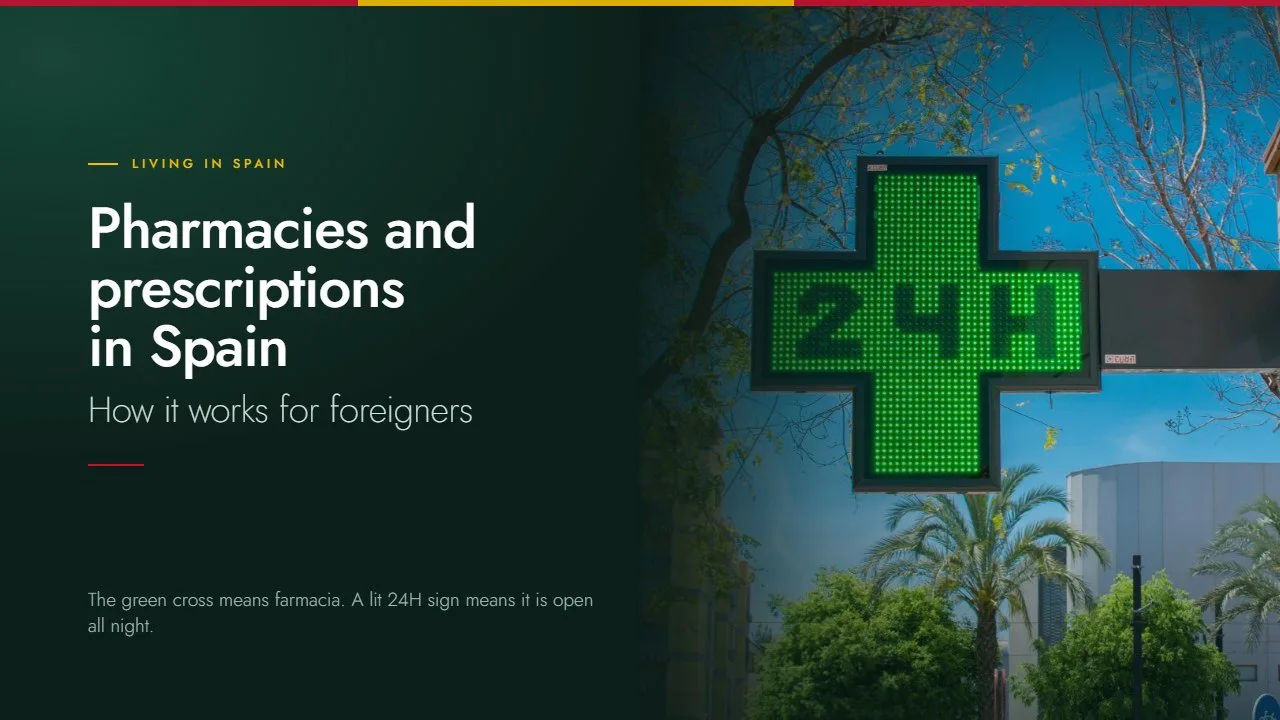
Every pharmacy door lists the farmacia de guardia for the area that day, and the regional health app shows the nearest one open. Larger towns have 24-hour pharmacies.
Why is the medicine I was given a different brand from last month?
Doctors prescribe by active ingredient and the pharmacist dispenses the cheapest equivalent in stock, so the manufacturer on the box can change. It is the same medicine at the same dose.
Can someone else collect my prescription?
Yes. Whoever goes to the pharmacy hands over your health card and the pharmacist dispenses what is due. Nothing else is needed.
Do I need a health card to buy over the counter?
No. Anyone can buy non-prescription medicines at any pharmacy. The card is only for prescriptions.
This article is general information about pharmacies and prescriptions in Spain, not medical, immigration or insurance advice. Rules are applied regionally and change, so check the current position with your regional health service, your pharmacist or a qualified adviser. Foxes is a Spanish mortgage and legal firm registered with the Bank of Spain, registration D470.