
Spain has no buy to let mortgage. You take an ordinary Spanish mortgage and you are free to rent the property out afterwards. How much a bank will lend depends on whether you will use the home yourself or it is only an investment.
How a Spanish bank treats a property you plan to rent out
In the UK a buy to let loan is a product of its own, and the lender works out the loan from the expected rent. In Spain there is no separate product and the bank ignores the expected rent. It lends on the income you already have, and the mortgage is the same one a holiday home buyer gets.
You do not need the bank’s permission to let the property once the mortgage is in place, and there is no rule that you must live in it. The bank does ask what you intend to do with it, because that decides how much it will lend.
How much you can borrow: holiday home or pure investment
These are the usual limits for a buyer who lives outside Spain.
| What you will do with it | The most a bank typically lends |
|---|---|
| Use it yourself and let it when you are not there | Up to 70% of the price |
| Never use it: an investment only | 50%, sometimes 60% |
| A unit on land zoned for hotel use, such as an aparthotel | 60% at most |
| A country property on rustic land | Normally 60% at most |
A few banks lend up to 80% to a buyer living abroad in some circumstances, but not for a pure investment. The percentage applies to the price or the bank’s valuation, whichever is lower.
Tell the bank your real plans. A second home you will use for part of the year is treated differently from a flat bought only for the rent.
The deposit on a 250,000 euro apartment
A smaller mortgage means a bigger deposit. Here is the same apartment bought three ways by someone living abroad. Purchase tax is set by each region. This example uses 7%, the rate on a resale home in Andalucía, and about 4% for fees.
| 250,000 euro resale apartment | You also use it (70%) | Investment (60%) | Investment (50%) |
|---|---|---|---|
| The mortgage | 175,000 | 150,000 | 125,000 |
| Deposit | 75,000 | 100,000 | 125,000 |
| Purchase tax (7%) | 17,500 | 17,500 | 17,500 |
| Fees, about 4% | 10,000 | 10,000 | 10,000 |
| Your own money | 102,500 | 127,500 | 152,500 |
So an investment purchase needs 25,000 to 50,000 euros more of your own money on the same apartment. The purchase costs calculator gives the tax and fees for your region and price.
The rent you expect does not help you qualify
A bank will not count rent that has not started. It judges your application on the income you can prove today, whatever the property could earn.
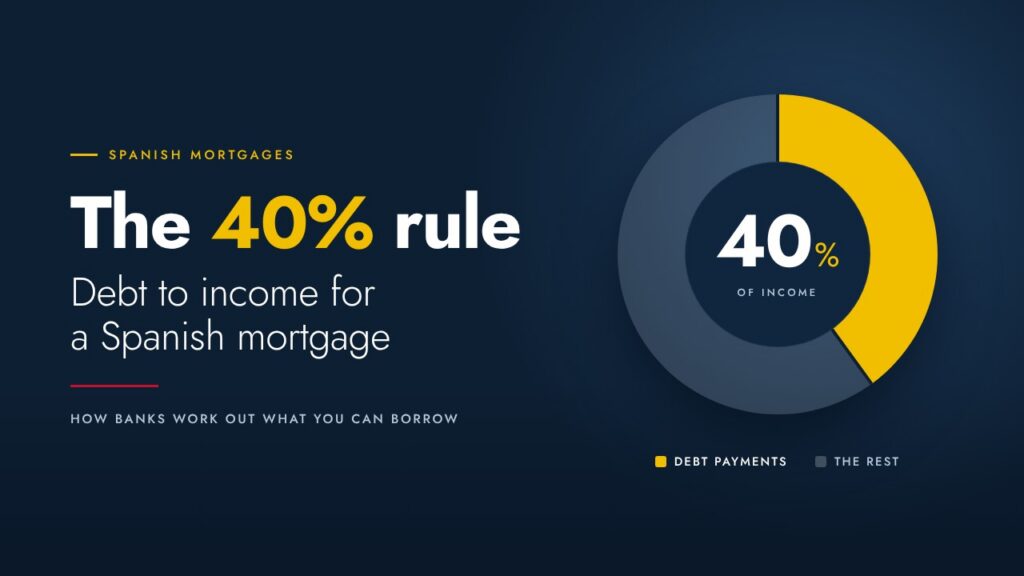
The rule is the same as for any borrower: all your monthly debt payments, with the new mortgage included, have to stay under 40% of your net monthly income. If you can only afford the mortgage with the rent, a bank will say no. See the debt to income ratio.
Rent you already receive can count
If you already let out other property, in Spain or in your home country, that income can be included in the application. How much of it counts depends on the kind of let.
Long-term lets: 70% of the gross rent
With a tenancy agreement in place, a bank counts 70% of the rent before expenses. That is usually better for you than the net figure on a tax return.
Holiday lets: the net figure from your tax returns
Short-term letting income goes up and down, so a bank takes the net amount declared on your tax returns, not 70% of the bookings.
The mortgage on that property counts in full
The rent is added to your income and the payment on the let property is added to your debts. The bank does not subtract one from the other.
It has to be yours, declared and in a major currency
The property must be in your own name, not a company’s. The rent must be declared for tax, and paid in a currency such as euros, pounds or Swiss francs.
An example. You earn 4,000 euros a month after tax and receive 1,000 euros a month from a long-term let that still has a 600 euro mortgage payment. The bank counts 700 euros of the rent, so your income is 4,700 euros and your debt limit is 1,880 euros a month. Take off the 600 euros and 1,280 euros a month is left for the new mortgage payment. Without the let and its mortgage it would be 1,600 euros. So a rental that still has a mortgage can reduce what you can borrow.
As evidence a bank asks for the tax returns that show the rent or, for a let too recent to appear on one, the tenancy agreement and bank statements showing the rent being paid.
Long-term let or holiday let: the rules are different
The mortgage is the same for both. The legal rules are different.
A long-term let to a tenant needs no licence.
A holiday let has to be registered with the region before you advertise it, and each region has its own rules. Three things apply across Spain:
The building can ban it
A community of owners can ban holiday lets in its statutes. Since April 2025, starting a new holiday let in a community building needs the approval of three fifths of the owners.
You need a national registration number as well
Since July 2025 the booking platforms only list properties that have a number from Spain’s single rental register. This is on top of the regional registration.
A licence does not always pass to the buyer
You normally apply after completion, in your own name. In the Valencia region, for instance, a buyer has to register again even where the seller was registered. The Alicante rules are set out in our guide to buying property in Alicante. Some towns have stopped accepting new holiday lets altogether.
If your plan depends on holiday rental income, do these checks before you pay a reservation. An advert that says “tourist licence” is not proof.
A bank also looks more closely at a home that is already let to tourists, and its terms can be stricter if you intend to carry on. Tell us at the start so the application goes to a bank that accepts it.
New national rules on letting, in force now
A national decree (Real Decreto-ley 29/2026) changed several rules for landlords. Parliament confirmed it on 12 November 2026. These are the changes that matter if you are buying to let.
| What changed | The rule now |
|---|---|
| VAT on holiday lets | From 1 December 2026, a furnished let of 30 nights or less to the same guest is charged 10% VAT, which the owner charges and declares. A let of your own main home is excluded. |
| Length of a holiday let | No more than 31 days. A region can set a shorter limit. |
| Seasonal lets (over 31 days) | The contract needs a real, provable reason why the tenant is there temporarily, and normally lasts no longer than 12 months. More than two in a row with the same tenant in the same home are treated as an ordinary long-term tenancy. |
| Rent rises on long-term lets | Until 31 December 2027, the yearly rise is capped at 2% unless you and the tenant agree otherwise, and there is no rise where the rent is already above the official reference index. |
| Longer tenancies | A tenant who has paid the rent on time can ask for up to two more years, a year at a time. |
| Council tax (IBI) on holiday lets | In towns declared a stressed housing area, the town hall can add up to 50% to the IBI on a home used for holiday lets, and more for owners with several. |
The decree also changes the Spanish income tax relief for landlords who let a home to a long-term tenant. For contracts signed after 1 December 2026 the relief is between 15% and 100% of the net rent, and it is higher where the rent is lowered. Whether it applies to you depends on where you pay tax.
These rules were made by decree, and a new parliament can change them. We update this page when they do.
How Foxes handles an investment purchase
We arrange the mortgage with all the major lenders, and our own lawyers check the property. On a purchase bought to let, that means reading the community statutes and recent minutes for a ban, checking any existing registration, and telling you what the region and the town allow before you are committed.
We act across Spain, for buyers living abroad and residents, on mortgages from 60,000 euros and prices from 100,000 euros. The full legal list is in legal checks before buying property in Spain, and the lending rules for buyers abroad are in non-resident mortgages.
See what a bank would lend you
My Score takes about a minute and uses the income you have now, which is how a bank will judge the application. The calculator then shows the monthly payment.
Common questions
Can I get a buy to let mortgage in Spain?
Not as a separate product. Spanish banks give a standard mortgage and you can rent the property out once it is in place. If the purchase is purely an investment, expect a bank to lend 50%, sometimes 60%, of the price.
Will the bank count the rent I expect to earn?
No. Rent from the property you are buying has not started, so it is left out. The bank uses the income you can already prove, and your total debt payments must stay under 40% of it.
How much deposit do I need for an investment property in Spain?
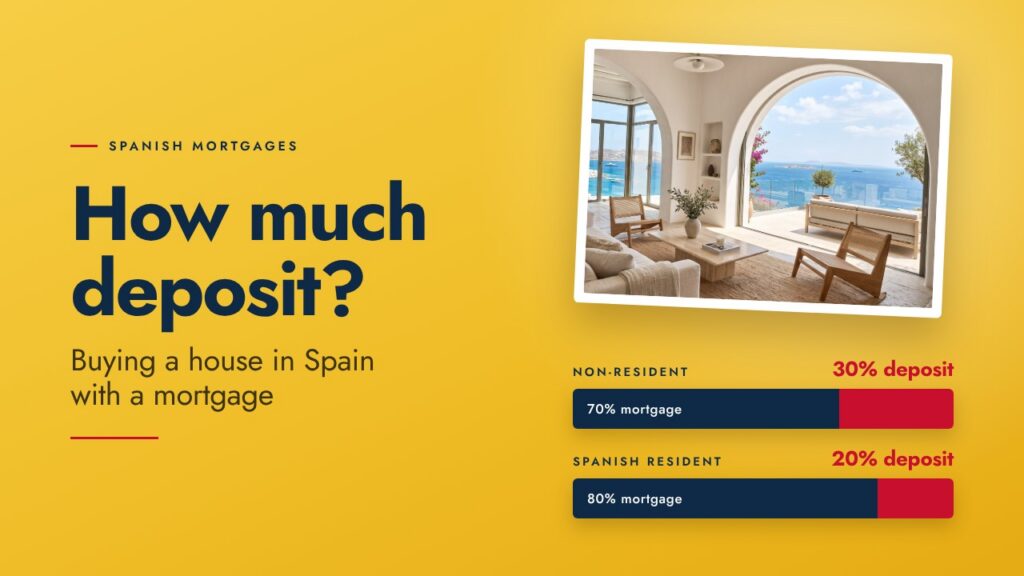
Between 40% and 50% of the price if you will never use it yourself, plus the purchase tax and about 4% in fees. If you will use it as a holiday home and let it at other times, the deposit is typically 30%.
Do I need my bank’s permission to rent out a mortgaged home in Spain?
No. A Spanish mortgage does not stop you letting the property, long term or to holidaymakers. The limits are set by the region, the town and the building, not by the bank.
Do I need a licence to rent out a property in Spain?
Not for a long-term let to a tenant. A holiday let needs a regional registration, a number from the national single rental register, and a building whose community of owners allows it.
Is there VAT on holiday lets in Spain?
Yes, from 1 December 2026. A furnished let of 30 nights or less to the same guest is charged 10% VAT, unless the home is the owner’s own main residence. Before that date a holiday let was exempt unless the owner provided hotel-type services.
I already own rental property. Does that help my application?
It can. A bank counts 70% of the gross rent from a long-term let in your own name, or the net figure on your tax returns for a holiday let. Any mortgage on that property is counted in full as a debt.
Foxes is a credit intermediary registered with the Bank of Spain (D470), not a lender. The figures here are a guide and each bank sets its own terms after a full assessment. Rent from a Spanish property is taxed in Spain, including for owners living abroad. This guide does not cover that tax, so take tax advice before you buy. National letting rules from Real Decreto-ley 29/2026, checked against the official bulletin on 24 November 2026.