

Before you buy property in Spain, your lawyer should check who owns it, what is registered against it, whether everything on it was built legally and which of the seller’s debts would pass to you. In Spain some debts and any illegal building work stay with the property when it is sold, so a problem the seller leaves behind can become yours. The checks are done after you reserve and before you sign the contract that commits your main deposit. Below is the full checklist for resale, country and off-plan homes: what to check, the document that proves it, and when.
Which checks apply to your purchase?
Every resale purchase needs the same core checks. A country property adds checks on the land, and an off-plan home has its own list. If you plan to rent the property to holidaymakers, or it is close to the sea, add those checks too.
| You are buying | Main checks | Read |
|---|---|---|
| A resale home (flat, townhouse or villa) | Owner and charges, paperwork against reality, licences, debts that pass to you, tenants, holiday let rules if you will rent it out | The core checks |
| A country property on rustic land | All of the above, plus what the land allows, the real boundaries, access and water, and illegal building or subdivision | The core checks, plus country property |
| An off-plan home | The developer, the plot and its charges, the building licence, the guarantee and special account for every payment, insurance and occupation at handover | Buying off plan |
When are the checks done?
When your offer is accepted you pay a reservation deposit, typically around €3,000, and the property comes off the market. Your lawyer then runs the checks before you sign the arras contract on a resale, or the private purchase contract with the developer off plan, and pay the main deposit. Until then a problem can be negotiated, fixed by the seller or walked away from. After it, pulling out usually means losing the deposit. Ask for the reservation agreement to be signed by the seller, not only the agent, and to say the reservation is refunded if the checks find a problem.
Most of these checks take a few days. A planning certificate from the town hall can take longer, so it is requested first. The documents come from the Land Registry, the Catastro (the land and property register used for tax), the town hall, the community of owners and the seller. Some answers only come in writing close to completion, such as the certificate of community debts, so the checks run in two rounds: before the arras and again just before you sign at the notary.
On a resale or country property, the checks fit into the buying process at four points. Off plan has its own order, covered under buying off plan below.
Once the property is reserved
The nota simple, the Catastro record, the planning position and, for a holiday let, the community rules and the local rules. Your lawyer also reads the recent community minutes for any special levy (derrama) already approved, and the arras contract says who pays it. This is your window to negotiate, ask the seller to fix something or walk away.
In the arras contract
Whatever the first round could not settle goes into the contract as a condition: the property delivered free of charges and occupants, the seller’s mortgage cancelled at completion, and the documents the seller must hand over. The deposit should be penitential arras: if you pull out you lose it, and if the seller pulls out they repay double. Our arras guide explains the types.
The week before completion
A fresh nota simple, the community debt certificate, the last IBI receipt, the energy certificate and the figures for any mortgage the seller still has to repay.
At the notary and straight after
The notary checks identities, the payments and the registry on the day, and alerts the registry straight after signing. If the seller is non-resident, the 3% is held back and paid to the tax office within a month. Your deed is registered once the transfer tax is paid and the plusvalía has been declared to the council.
Who owns it, and what is registered against it?
The first document your lawyer asks for is the nota simple, an extract from the Land Registry (Registro de la Propiedad). It arrives within hours. It shows:
What it does not show matters as much: unpaid community fees, unpaid council tax, tenants or anyone living in the property, and usually planning breaches, although open enforcement proceedings can be noted on it. Those need the other checks below. The nota simple is also a snapshot, so your lawyer orders a fresh one just before completion to make sure nothing new has been registered since.
Does the property match the paperwork?
A Spanish property is described in two official places that do not always agree: the Land Registry, which protects ownership, and the Catastro, which values the property for tax and holds the official map. Your deed must quote the catastral reference. Your lawyer compares the two with each other and with what you actually saw.
The common mismatches are a plot that measures differently, a pool, garage or extra room that the registry does not mention, or a house the registry still calls a plot of land. Small differences can often be corrected before or after completion. Larger ones affect the price, the mortgage valuation and your ability to sell later, so they need to be understood before you commit. Since 2015 the two registers have been linked: once a property is marked as coordinated, its boundaries and area on the Catastro map are presumed correct.
Which debts pass to you with the property?
In Spain some debts belong to the property, not to the person who ran them up. If the seller leaves them unpaid, they can be claimed from you as the new owner. These are the ones to check:
| Debt | What can pass to you | How it is checked |
|---|---|---|
| Community of owners fees | Unpaid fees for the current year and the three previous years, including unpaid special levies (derramas) | A certificate of debts signed by the community’s secretary with the president’s approval. The notary will not sign the sale without it unless you expressly waive it. Do not waive it. |
| IBI (the yearly council property tax) | Unpaid IBI the council can still collect, usually the last four years (older if it has kept pursuing the seller). It can only come to you once the council has tried and failed to collect from the seller, and you owe the tax only, not the surcharges or interest. | The latest IBI receipt and a certificate from the council or its tax collection office |
| Plusvalía municipal (the council tax on the gain in land value) | Normally the seller’s tax. If the seller is a non-resident individual, the law makes the buyer responsible for paying it to the council. | Your lawyer calculates it. The amount is kept back from the price and stays in your account until the council’s formal letter arrives, and then you pay it |
| Non-resident seller’s income tax | This applies only if the seller is not resident in Spain. If you do not hold back 3% of the price and pay it to the tax office, the property stays liable for the seller’s tax on the sale, up to that 3% | 3% held back at the notary and paid on form 211 within one month of completion |
Many urbanisations on the coast also have a separate conservation body (entidad urbanística de conservación) that looks after roads, lighting and gardens and charges its own fees. Ask for its debt certificate as well as the community’s.
Utility bills are different: debts for electricity, water and gas belong to the account holder, not the property. Still ask for the latest bills, take the meter readings on the day and move the contracts into your name straight after completion. Our guide to purchase costs covers the taxes you pay as the buyer, and our guide to selling property in Spain explains the 3% from the seller’s side.
Was it built legally?
Most of the costly problems are found here, especially on villas, country houses and older properties on the coast. Your lawyer checks three things with the town hall’s records and the property’s own documents.
Was it built with a licence?
The building licence, or for later works the planning declaration filed with the council, should cover what is there today. Pools, porches turned into rooms, extra floors and garages turned into flats are the usual gaps. The registry only records new buildings with the licence and an architect’s certificate, or, for older buildings, with proof of when they were finished, so what is registered is a useful starting point but not proof that everything on the plot is legal.
Can it be lived in?
Each region has its own document that shows a home can be lived in, and your lawyer checks the one for the property’s area. In Andalusia and the Valencia region, for instance, the old first occupation licence has been replaced by a planning declaration (declaración responsable) filed with the council, so your lawyer looks for that declaration, or the old licence for older homes. Catalonia and the Balearic Islands require a habitability certificate (cédula de habitabilidad). In Catalonia it is needed to sell, and is valid for 25 years for a new home and 15 years after that.
What if something was built without permission?
Each region sets a time limit for the council to act against works built without a licence, counted from when the works were finished. It runs from four to fifteen years: for instance, four years in Murcia and the Canary Islands, six in Andalusia, Catalonia and Galicia, eight in the Balearic Islands and fifteen in the Valencia region. Once that time has passed, the council can usually no longer order the works to be removed, but the building does not become legal.
What the owner can do next also depends on the region. In Andalusia, for instance, the owner can apply to the council for a formal declaration that the building is “asimilado a fuera de ordenación”, known as AFO, backed by a technical report. Once granted, it can be recorded in the Land Registry, and the building can stay, be repaired and be connected to water and electricity, but it is not legal, it cannot be extended, and it cannot get an occupation declaration. Until the council grants it, the building is only out of time for enforcement, so ask whether the seller already holds the AFO decision.
Some land has no time limit at all. The list is set by each region and typically covers green zones, public land and protected rustic land. In Andalusia, for instance, it is green zones and open spaces, public land and its protection strips, rustic land in the coastal influence zone, land at risk of flooding or other hazards, listed heritage and illegal subdivisions of rustic land. On that land the council can act whenever it likes, however old the building is. Your lawyer checks the rule where the property is.
For a mortgage, this status matters. The bank’s valuation will flag it, and many lenders lend less on a property like this, or not at all. If you are buying a country property, read our guide to buying rustic property in Spain before you make an offer, and tell your broker about the status early.
Is anyone living there?
The registry rarely shows tenants or occupants. Visit before you sign, and again just before completion if you can, and make the arras contract say the property will be handed over empty. If a home is let, you must honour the lease for the rest of its legal minimum term (five years, or seven if the landlord is a company), even if it is not registered. A tenant may also have a legal right to buy before you, so the seller must notify them and wait 30 days, or show that they waived it in the lease. If this is skipped, the tenant can take the purchase over from you.
Is there an energy certificate?
The seller must provide an energy performance certificate (certificado de eficiencia energética), and the rating has to appear in the property’s adverts. It does not stop a sale on its own, but a missing certificate is a sign of a seller who has not prepared, and the notary will ask for it.
Those are the core checks. The next sections cover the extra checks for country, off-plan, coastal and holiday-let purchases.
Buying a country property on rustic land
A villa or finca on rustic land needs the core checks plus checks on the land itself, because the rules for building and living on rustic land are much stricter than in a town.
Our guide to buying rustic property in Spain covers each of these in detail.
Buying off plan
With the home not built yet, your lawyer checks the project instead of the property, before you sign the private purchase contract and before every payment after it.
Our off-plan guide covers the payment stages and the rest of the process.
Buying near the sea
Spain’s coastal law (Ley de Costas) protects a strip of land behind the beach. No new homes can be built within 100 metres of the shoreline boundary, or 20 metres on land that was already urban in 1988, and a 6-metre path along the shore must stay open to the public. Homes built there legally before the law can be kept, repaired and improved. Homes that fall inside the public shoreline itself are held under a state concession, not owned. If the property is close to the sea, your lawyer checks the official shoreline boundary with the Coastal Authority, because the registry does not always reflect it, and whether any recent works had coastal authorisation.
Buying to rent out to holidaymakers
If rental income is part of your plan, ask your lawyer to do this check first, because the answer can be no.
The national rental registration number introduced in July 2025 was largely annulled by the Supreme Court in May 2026, so the regional registers are the ones that count.
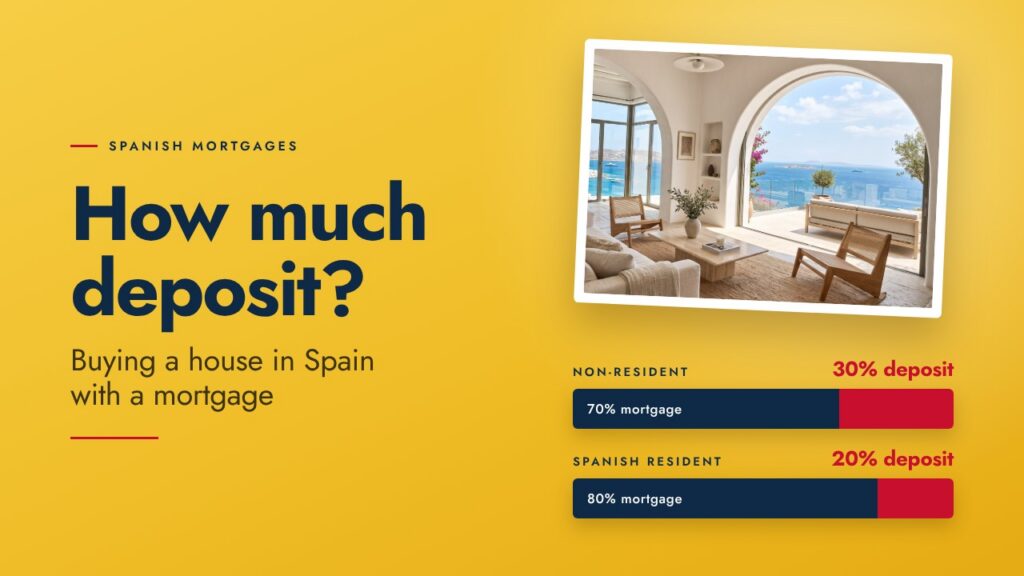
If you are taking a mortgage
If you are borrowing, the bank orders a valuation from an approved valuer (it must also accept a valid one you provide), who inspects the property and compares it with the registry and the Catastro. Anything irregular appears in the valuation report, and the bank decides how much to lend on that basis. That is useful protection, but it comes late. At Foxes the lawyers sit with the mortgage desk, so the legal checks and the bank’s conditions run side by side and a problem shows up before the valuation, not after. The bank’s binding offer must also reach you at least 10 days before completion, and you see the notary free of charge beforehand, so build that into the completion date. Our guide to Spanish mortgages explains the rest of the mortgage process.
The checklist
| Check | Document | When |
|---|---|---|
| Owner and charges | Nota simple from the Land Registry | Before the arras, and again before completion |
| Property matches the paperwork | Catastro record and map, compared with the registry and a visit | Before the arras |
| Community fees paid | Certificate of community debts | Just before completion |
| Council tax paid | Latest IBI receipt, council debt certificate | Before completion |
| Built and extended legally | Building licence or planning declarations, town hall records | Before the arras |
| Fit to live in | Occupation declaration or licence (cédula in Catalonia and the Balearic Islands) | Before the arras |
| Urbanisation fees paid | Conservation body debt certificate, if there is one | Just before completion |
| Seller can sell | Spouse consent for a family home; protected housing (VPO) status on the nota simple, confirmed with the regional housing office | Before the arras |
| Energy rating | Energy performance certificate | Before completion |
| Holiday lets allowed | Community rules and minutes, council rules, tourism registration | Before the arras |
| Coastal position | Coastal boundary map, registry notes | Before the arras |
| Off-plan payments protected | Bank guarantee or insurance covering every payment | Before each payment |
| Non-resident seller | 3% held back, form 211; plusvalía calculated | At completion |
| Tenants | Any lease, and notice to the tenant of their right to buy first | Before the arras |
| Empty on completion | Arras clause, visit, any lease | Arras and completion day |
Want us to run these checks for you?
Independent English-speaking Spanish lawyers, registered with the Madrid Bar Association. We act for you and nobody else, not the seller, the agent or the developer. Our fee is 1% of the price plus IVA, with a minimum of €2,500 plus IVA, half on engagement and half on completion. If you also need a mortgage, our brokerage is registered with the Bank of Spain (D470).
Frequently asked questions
What checks should a lawyer do before I buy property in Spain?
It depends on the property. For a resale home: ownership and charges on the nota simple, a comparison of the registry, the Catastro and the property itself, the planning and licence position, debts that pass with the property, tenants and, if you plan to rent it out, the holiday let rules. A country property adds checks on the land, its boundaries, access and water. Off plan, the checks are on the developer, the plot, the building licence and the guarantee for every payment.
When should the legal checks be done?
After your offer is accepted and the property is reserved, and before you sign the arras contract and pay the main deposit. Some checks are repeated just before completion, including a fresh nota simple and the certificate of community debts.
Do I inherit the seller’s debts when I buy in Spain?
Some of them. Unpaid community fees for the current year and the three before it pass with the property, and so can unpaid IBI council tax once the council fails to collect it from the seller. Personal debts and utility bills do not.
What is a nota simple?
An extract from the Spanish Land Registry showing the owner, a description of the property and any mortgages, seizures or other charges. It costs €9.02 online. It does not show community or council tax debts or tenants, and usually not planning problems.
Can I buy a property with an illegal extension in Spain?
Yes, but understand the risk first. Each region sets a time limit, from four to fifteen years, after which the council usually cannot act against the works. In Andalusia, for instance, it is six years, and the owner can then apply for a formal AFO declaration. The building then stays, but it is not legal and cannot be extended, and some land has no time limit at all. Many banks lend less, or nothing, on a property like this.
What happens if the seller is not resident in Spain?
You hold back 3% of the price at completion and pay it to the tax office on form 211 within one month. If the seller is a non-resident individual, you must also pay the seller’s plusvalía municipal to the council. That amount is kept back from the price and stays in your account until the council’s formal letter arrives. If the seller is resident in Spain, none of this applies.
Can my community stop me renting to holidaymakers?
Yes. Since 3 April 2025 a new holiday let in a community of owners needs the community’s express approval, by a vote of three fifths of the owners. Lets registered before that date can carry on. Check the community rules and recent minutes before you buy if rental income matters to you.
Sources: Ley de Propiedad Horizontal, articles 9.1.e and 17.12 (consolidated text, BOE, October 2026); Ley Orgánica 1/2025; Texto Refundido de la Ley Reguladora de las Haciendas Locales, articles 64 and 106; Ley General Tributaria, articles 41.3 and 66; Agencia Tributaria, form 211 instructions; Ley 7/2021 (LISTA), articles 138 and 153, Andalusia; Decreto Legislativo 1/2010, article 207, Catalonia; Decreto Legislativo 1/2021 (LOTUP) and Decreto 12/2021, Valencia region; Ley 12/2017, Balearic Islands; Ley 13/2015, Murcia; Ley 4/2017, Canary Islands; Ley 2/2016, Galicia; Texto Refundido de la Ley de Suelo, article 28; Real Decreto 390/2021 on energy certificates; Decreto 31/2024, Andalusia, on holiday lets; Supreme Court judgment 620/2026 of 19 May 2026 on the national rental registry; Ley de Costas and Ley 2/2013; Ley de Ordenación de la Edificación, first additional provision; Colegio de Registradores, nota simple fees; Dirección General del Catastro.