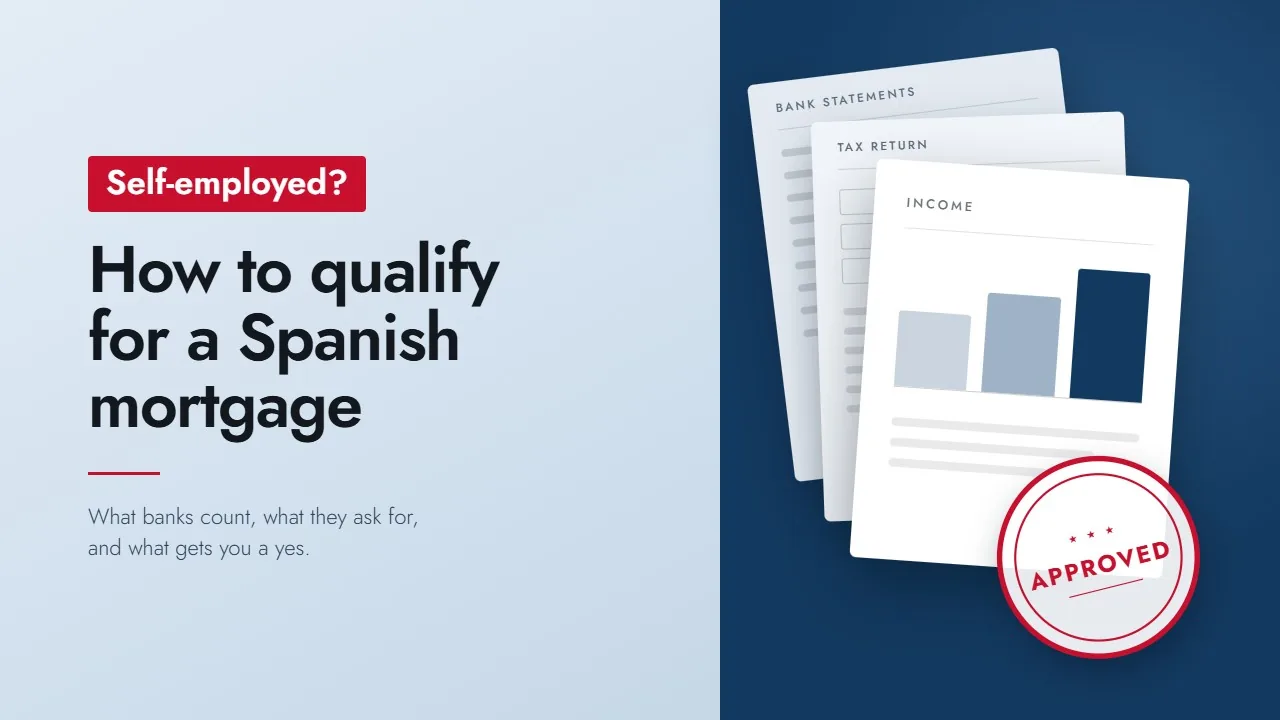

Yes, you can qualify for a Spanish mortgage if you are self-employed. Spanish banks lend to sole traders, freelancers and company directors on the same rates and loan limits as employees, as long as the income is well documented. The difference is how you prove your income and how the bank reads it. Instead of payslips, the bank works out your income from your last three years of tax returns, usually as an average, and it wants clean records and steady or rising profits.
How do Spanish banks work out self-employed income?
The bank does not use your turnover. It uses the profit you declare to the tax authority, after tax, because that is the money you have to live on and to repay a mortgage. For a sole trader that is the net profit on the tax return. Most banks take an average of the last three years rather than the latest year on its own, and they read self-employed income more cautiously than a salary, because profits can rise and fall.
| Your last three years | How a bank usually reads it |
|---|---|
| Steady or rising profits | The best position. The bank uses the average, and a few lenders will use the latest year. |
| One strong year after two weaker ones | The average is used, so the strong year is diluted. Do not plan your budget on the latest year alone. |
| Profits falling in the latest year | The bank may use the lower latest figure instead of the average, and will ask why it fell. |
Be careful with expense claims. Every expense you claim lowers your declared profit, and declared profit is the income the bank uses. Claiming everything you can is good tax planning, but in the three years before you apply it also shrinks what you can borrow.
Can a company director get a Spanish mortgage on salary and dividends?
Yes. If you own and run a limited company, the bank looks at two things together: what you take out of the company, and the health of the company itself. Your personal income is the salary and dividends on your tax returns, and three years of company accounts show whether that income can continue.
Paid by payslip from your own company? Many owners pay themselves a salary through payroll. The payslips look like employment, but because you set your own pay, banks usually treat you as self-employed: they read the payslips together with the company’s accounts and tax returns, and check the business can keep paying you.
How much can you borrow when you are self-employed?
Two rules set the limit. First, your total monthly debt repayments, including the new Spanish mortgage, must be no more than 40% of your net monthly income. Second, the loan cannot be more than 70% of the property’s valuation if you are a non-resident, or 80% if you live in Spain.
On rural property, banks normally lend 60% at most. Most Spanish banks will not lend less than about €60,000, and they want a minimum income of around €2,000 a month after tax for a single applicant. The lending guide explains each rule.
For example, take a sole trader whose declared profits after tax average €50,000 a year over the last three years and who pays €300 a month on car finance. At a fixed rate of 3.15% over 25 years, what the bank lends depends on the figure it uses:
| Income the bank uses | Left for the mortgage each month | Loan |
|---|---|---|
| The three-year average €50,000, so €4,167 a month |
€1,367 | €283,500 |
| The latest year, if profits rose to €56,000 €4,667 a month |
€1,567 | €325,000 |
| The latest year, if profits fell to €44,000 €3,667 a month |
€1,167 | €242,000 |
Most banks would use the average, but the same three years of profits can support anything from €242,000 to €325,000 depending on the trend and the lender. Existing debts matter too: in this example the €300 a month of car finance alone cuts what can be borrowed by about €62,000.
Using the average, a non-resident borrowing €283,500 at 70% could buy a property of around €405,000, as long as it values at the price. They would need a 30% deposit plus 10 to 12% for taxes and fees. Run your own figures in the mortgage calculator.
What documents do you need for a self-employed mortgage in Spain?
Everyone needs a passport and six months of bank statements for the account your income goes into. You also need a full credit report from the country where you live (Experian or Equifax in the UK), proof of where your deposit comes from, and an NIE, the Spanish tax number for foreigners, before completion.
The income documents are the same in principle wherever you work: three years of tax returns, plus company accounts if you have a company. Each country has its own forms:
| Your situation | Income documents |
|---|---|
| UK sole trader or freelancer | The last 3 years of Self Assessment returns (SA100), each with its HMRC tax calculation (SA302) and the matching Tax Year Overview. |
| UK company director | The last 3 years of year-end company accounts, plus the last 3 years of SA100s with their SA302s and Tax Year Overviews for your personal income. Payslips if you also take a salary. |
| Self-employed in Ireland, the Netherlands, the US, the UAE or elsewhere | The last 3 years of tax returns from the country where you pay tax, with business accounts or an accountant’s statement of profit. Where there are no personal tax returns, as in the UAE, 3 years of audited business accounts. |
| Autónomo resident in Spain | The last 3 years of income tax returns (Modelo 100), this year’s quarterly returns where you file them (Modelo 130 or 131, and VAT on Modelo 303), last year’s VAT summary (Modelo 390), certificates that you are up to date with the tax office and Social Security, and your vida laboral (your Social Security work history). |
Some banks read English documents directly. Others ask for a sworn translation into Spanish, so ask before paying for translations. Order your credit report early, as it can take a few days to arrive. UK buyers can download the SA302 and the Tax Year Overview from their HMRC online account.
How long do you need to have been self-employed?
There is no legal minimum, but most Spanish banks want at least two full tax years of self-employed income, with the returns filed, and then average those two years. With less than that, the bank has no reliable average to work from, so many applications stall at this point.
A shorter history can still work if you were doing the same work as an employee before going self-employed, if a second applicant has stable income, or if you put down a bigger deposit. It depends on the lender, so ask before you start viewing properties.
Why are self-employed mortgage applications refused in Spain?
The three most common reasons are covered above: declared profit too low after expenses, profits falling in the latest year, and less than two years of history. Other common reasons:
Unpaid tax
Any unpaid tax or Social Security contributions, wherever you pay them. An agreed payment plan may still need explaining to the bank.
Debts over 40% of income
Car finance, loans, credit cards and other mortgages all count. See our guide to what Spanish banks check.
Missing or unclear paperwork
Accounts that do not match the tax returns, business and personal money mixed in the same account, or unexplained large payments.
How to make your application stronger
Self-employed? See where you stand first
Our pre-qualification check asks the questions a Spanish bank would, including how your income is earned, and tells you whether you are likely to qualify. We then send your application to lenders suited to self-employed income. Foxes is registered with the Bank of Spain (D470).
Frequently asked questions
Can I get a Spanish mortgage if I am self-employed?
Yes. Spanish banks lend to self-employed buyers, resident in Spain or not, on the same rates and limits as employees: up to 70% of the valuation for non-residents and 80% for residents, with total debts no more than 40% of net monthly income. You prove your income with tax returns and accounts instead of payslips.
How many years of accounts do I need for a Spanish mortgage?
Expect to give the last three years of tax returns, and most banks will not lend until you have at least two full years filed. In the UK that means three years of SA100 returns with their SA302 tax calculations, and company directors also give three years of company accounts. Buyers who pay tax elsewhere give the last three years of tax returns from that country.
Which income do Spanish banks use for the self-employed?
Your declared profit after tax, not your turnover, usually averaged over the last three years. If profits fell in the latest year, the bank may use that lower figure instead. Because the bank uses declared profit, claiming more expenses lowers the amount you can borrow.
Do self-employed buyers pay a higher mortgage rate in Spain?
No. Self-employed buyers get the same rates and loan limits as employees. What changes is the evidence the bank needs and how cautiously it reads your income.
Can a company director use dividends to get a Spanish mortgage?
Yes. Salary and dividends that appear on your personal tax returns count as income, and the bank also reviews three years of company accounts to check the business is profitable in its own right. Profit left in the company is treated case by case.
Can I get a mortgage in Spain with less than two years self-employed?
It is harder, but it can be done. It can work with a second applicant on stable income, a larger deposit, or evidence that you did the same work as an employee before. It depends on the lender, so check before you commit to a purchase.
What do autónomos in Spain need to apply for a mortgage?
The last three income tax returns (Modelo 100), this year’s quarterly returns where you file them (Modelo 130 or 131 and Modelo 303), last year’s Modelo 390, certificates that you are up to date with the tax office and Social Security, the vida laboral (your Social Security work history), and recent bank statements.
Sources: Foxes lending criteria and document checklist (Christopher Beall, Head Broker, October 2026); Banco de España, guidance on applying for a mortgage and the solvency assessment; HMRC, SA302 tax calculations and Tax Year Overviews (GOV.UK, updated September 2026); Agencia Tributaria, Modelo 100, 130, 131, 303 and 390; Seguridad Social, informe de vida laboral and certificate of being up to date. Rates are Foxes rates, reviewed October 2026.